The automobile industry is changing faster than ever. In 2026, a modern car is no longer defined only by its engine, gearbox, suspension and exterior design. Software, artificial intelligence, connectivity, sensors, batteries and digital interfaces are becoming equally important parts of the vehicle.
For Indian car buyers, this transformation is already becoming visible. New cars are increasingly offering connected features, advanced driver assistance systems, large digital displays, voice-controlled functions, over-the-air updates and multiple powertrain choices. At the same time, electric and hybrid technology is developing alongside conventional petrol and diesel engines.
The biggest change is that cars are becoming more like intelligent digital products. Software-defined vehicles, generative AI assistants and advanced digital cockpits are moving from technology demonstrations toward real-world automotive applications.
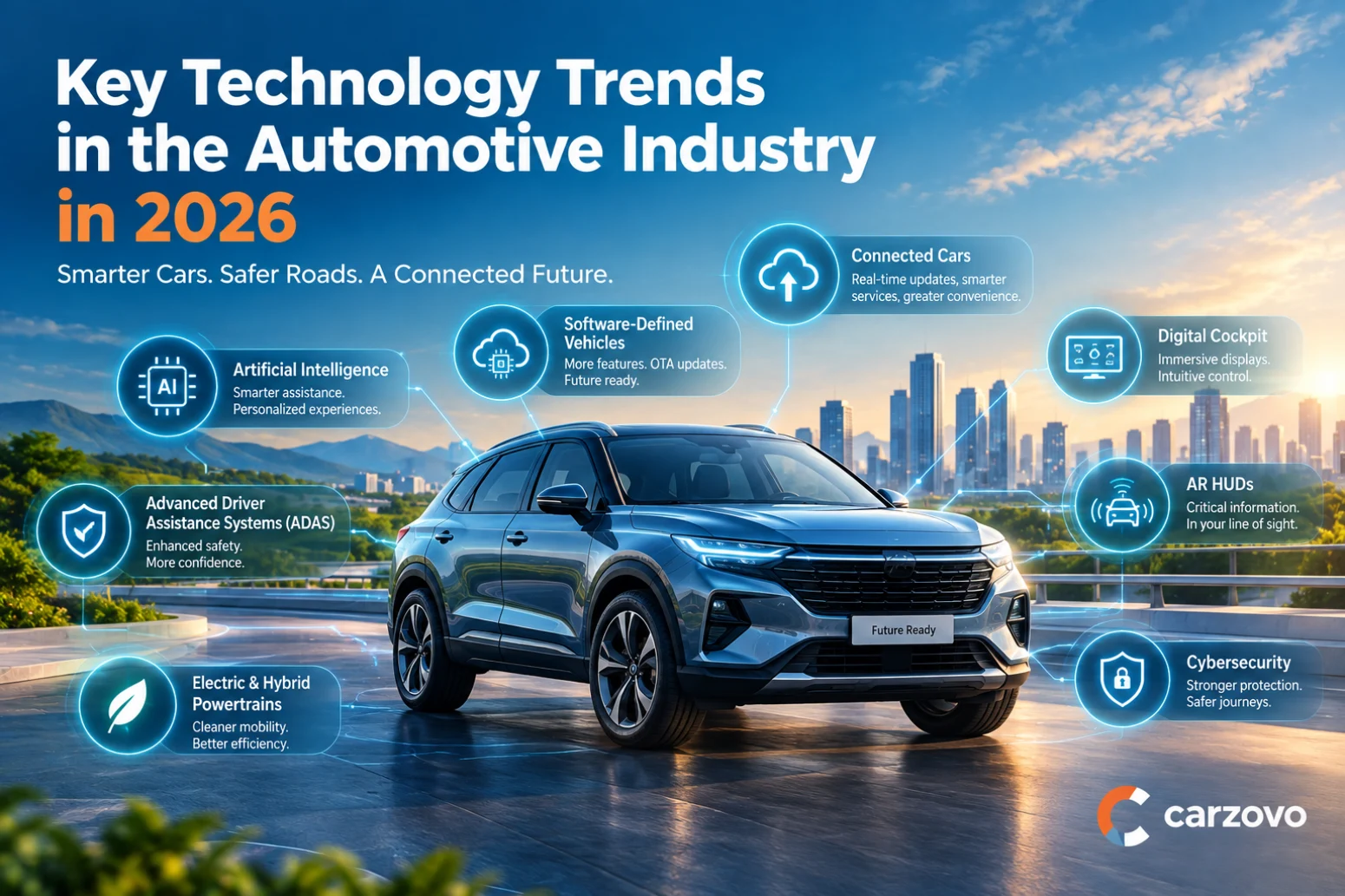
1. Software-Defined Vehicles Are Changing Car Technology
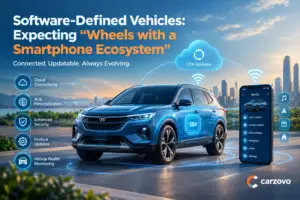
Software-defined vehicles, or SDVs, are among the most important automotive developments of 2026.
Traditional cars rely heavily on individual electronic control units for different functions. Modern SDVs are moving toward centralized or zonal electronic architectures where software can control a much wider range of vehicle functions.
This makes it possible for manufacturers to improve certain vehicle functions through software updates instead of depending entirely on physical hardware changes.
Over-the-air updates can potentially improve infotainment, navigation, battery management, driver assistance functions and other software-controlled systems during the vehicle’s lifetime.
The shift is also changing how manufacturers think about vehicle development. A car can increasingly be treated as a platform that evolves after it leaves the showroom.
The International Energy Agency notes that software-defined vehicles are increasingly moving toward domain and zonal architectures, while OTA updates can enable improvements and security updates during a vehicle’s lifetime.
2. Generative AI Is Entering the Car Cabin
Voice assistants are becoming more sophisticated.
Earlier automotive voice systems generally worked with predefined commands. Drivers might say a specific phrase to change the temperature, call someone or select music.
Generative AI can make these interactions more conversational.
A driver could potentially ask a vehicle a natural question such as, “Find a quiet restaurant on my route and tell me how long it will take to reach there.” The system can combine conversational understanding with navigation and connected services.
AI assistants can also understand context better, allowing drivers to continue a conversation instead of repeating complete commands.
In 2026, automotive AI is increasingly being developed as an interface between the driver and multiple vehicle functions.
Google, for example, has announced the integration of Gemini into cars with Google built-in, bringing more conversational interactions for navigation, information and other vehicle-related functions.
3. Advanced Driver Assistance Systems Are Expanding
ADAS is another major automotive technology trend.
Features such as adaptive cruise control, lane keeping assistance, automatic emergency braking, blind-spot monitoring, traffic-sign recognition and driver monitoring are becoming increasingly common.
The technology is also becoming more sophisticated through combinations of cameras, radar, ultrasonic sensors and increasingly powerful processors.
However, ADAS should not be confused with fully autonomous driving.
Most consumer systems available today still require the driver to remain attentive and responsible for the vehicle.
For Indian roads, ADAS development is particularly interesting because vehicles must operate in environments involving motorcycles, pedestrians, inconsistent lane markings, traffic congestion and unpredictable road behaviour.
4. Connected Cars Are Becoming More Intelligent
Connectivity is becoming a fundamental part of modern vehicles.
Connected cars can communicate with cloud services and smartphone applications to provide information such as vehicle location, fuel or battery status, service reminders, remote locking and climate control.
The next stage is moving beyond simple remote functions.
Connected systems can support predictive maintenance, personalized settings, navigation services, emergency assistance and software updates.
For buyers, the important question is not simply whether a car is connected. It is how useful those connected functions remain after several years of ownership.
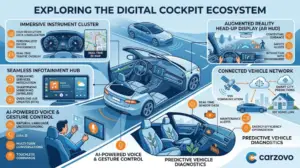
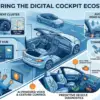
5. Digital Cockpits Are Replacing Traditional Interiors
The dashboard of a modern car is becoming a digital environment.
Large infotainment displays, digital instrument clusters, passenger screens, wireless smartphone connectivity and customizable interfaces are becoming increasingly important.
Premium vehicles are also adopting curved and pillar-to-pillar displays.
The trend is moving toward integrating multiple functions into a single digital cockpit rather than treating the instrument cluster, infotainment system and vehicle controls as completely separate systems.
Automotive display research published in 2026 highlights the movement toward immersive, intelligent and software-defined cockpit architectures, with larger displays and technologies such as HUDs and passenger screens becoming increasingly relevant.
6. Augmented-Reality Head-Up Displays
Head-up displays are becoming more advanced.
A conventional HUD projects information into the driver’s field of view. An augmented-reality HUD goes further by positioning digital information so that it appears related to the real road environment.
For example, navigation guidance can appear visually aligned with a road junction.
Instead of looking down at a central display to check the next turn, the driver could receive relevant information closer to their natural line of sight.
This can potentially reduce the need for repeated glances toward the dashboard.
7. Battery Technology and Intelligent Energy Management
Electrification remains a major technology driver in 2026.
Battery electric vehicles are receiving improvements in charging performance, thermal management, battery monitoring and energy efficiency.
But battery technology is not only about increasing range.
Modern battery management systems monitor temperature, charging conditions, cell behaviour and energy consumption.
Software can also optimize how the vehicle uses available battery energy.
Hybrid vehicles are simultaneously gaining importance because they can combine an internal combustion engine with electric assistance.
For Indian buyers, the result is a market offering more choices rather than a simple transition from petrol directly to electric vehicles.
8. Vehicle Cybersecurity Is Becoming More Important
As vehicles become connected and software-driven, cybersecurity becomes a critical part of automotive technology.
A connected car contains software, communication systems, sensors and digital interfaces. Protecting these systems from unauthorized access is therefore increasingly important.
Manufacturers must consider secure software updates, data protection, authentication and protection of vehicle networks.
Cybersecurity is no longer only an IT issue. It is becoming part of vehicle engineering.
9. Digital Twins and Predictive Maintenance
Digital twin technology can create a digital representation of physical vehicle systems.
When combined with vehicle data, manufacturers can use digital models to understand how components behave and identify potential problems.
Predictive maintenance can potentially detect unusual behaviour before a component fails.
This can improve maintenance planning and reduce unexpected downtime.
AI and virtual-twin technology are also increasingly being used in engineering and product development to simulate and optimize systems before physical implementation.
10. What These Trends Mean for Indian Car Buyers
Technology is quickly becoming one of the major differentiators between vehicles.
However, buyers should not choose a car simply because it has the biggest screen or the longest list of digital features.
The more important questions are:
- How useful are the technology features?
- Can the software be updated?
- How reliable is the connected system?
- Does the vehicle have effective safety technology?
- Are ADAS features suitable for Indian driving conditions?
- What happens when connected services expire?
- Can important functions still operate without internet connectivity?
The future car will combine mechanical engineering with software engineering.
The Road Ahead for Automotive Technology
The 2026 automotive industry is moving toward vehicles that are connected, updateable, intelligent and increasingly software-driven.
Software-defined architectures, AI assistants, ADAS, digital cockpits, connected services and advanced displays are no longer isolated concepts. They are becoming part of the broader automotive ecosystem.
For consumers, this means the definition of a “feature-rich car” is changing.
In the coming years, the difference between cars may depend not only on horsepower, mileage or dimensions, but also on computing power, software capability, connectivity and how effectively technology improves the driving experience.
The automobile is becoming a digital platform on wheels, and 2026 is an important stage in that transformation.