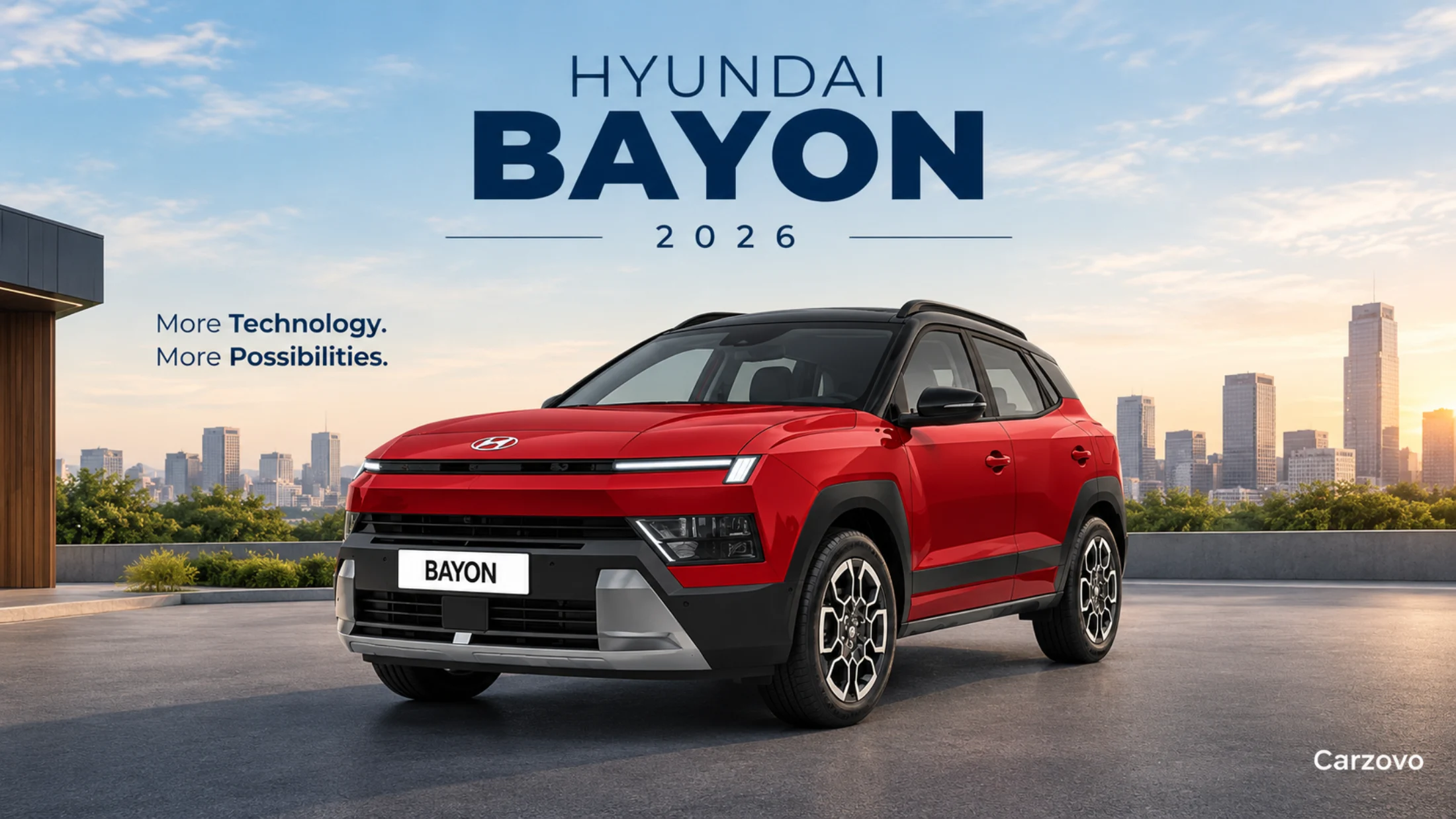
Hyundai has launched the new Hyundai Bayon in India on October 26, 2026, introducing a technology-focused SUV designed for modern Indian buyers. With an introductory starting price of ₹9.99 lakh (ex-showroom), the Bayon combines a contemporary exterior, a digital cockpit, advanced driver assistance systems and a familiar petrol engine.
The biggest highlight is Hyundai’s in-built generative AI voice assistant, which aims to make everyday driving more connected and convenient. The SUV also gets dual 12.3-inch curved panoramic displays, over-the-air software updates, a panoramic sunroof and a claimed 505-litre boot capacity.
The Bayon is positioned below the Creta in Hyundai India’s SUV lineup. It will also be manufactured in India for export to more than 50 markets, making the model important for Hyundai’s domestic product strategy and export plans.
For buyers exploring new SUVs in 2026, the Hyundai Bayon offers an interesting combination of technology, comfort, practicality and petrol-powered performance.
Hyundai Bayon 2026 Price in India
Hyundai has announced an introductory starting price of ₹9,99,900 for the Bayon. The SUV is offered with manual and Intelligent Variable Transmission (iVT) options across its variant lineup.
The available variants include HX2, HX3, HX3+, HX5, HX6, HX8 and HX10, with automatic transmission versions of selected higher trims.
| Detail | Hyundai Bayon 2026 |
|---|---|
| Starting price | ₹9.99 lakh |
| Price type | Introductory ex-showroom |
| Fuel type | Petrol |
| Engine | 1.5-litre MPi |
| Transmission | 6-speed manual / iVT |
| Seating capacity | Five |
| Vehicle category | SUV |
| Booking amount announced before launch | ₹11,000 |
The starting price is not the final on-road cost. Registration, insurance and other applicable charges will increase the amount payable. Buyers should also confirm the latest variant-wise prices and availability with an authorised Hyundai dealership before booking.
Exterior Design: A Modern SUV with a Distinctive Appearance
The Hyundai Bayon introduces a fresh design identity to the brand’s Indian SUV range. Its exterior combines sharp body lines, pronounced wheel arches and modern lighting elements to create a distinctive road presence.
At the front, the SUV features a sculpted bonnet, a futuristic fascia and H-Edge LED daytime running lights paired with dual LED projector headlamps. These elements give the vehicle a contemporary appearance while helping it stand apart from more conventional compact SUVs.
The side profile features geometric wheel arches, wraparound door cladding and bridge-type roof rails. Depending on the variant, buyers can also get 17-inch diamond-cut alloy wheels.
At the rear, H-Edge LED tail lamps, a sporty roof spoiler and a high-mounted stop lamp complete the design.
Hyundai Bayon dimensions
| Specification | Measurement |
|---|---|
| Length | 4,245 mm |
| Width | 1,810 mm |
| Height, with roof rails | 1,605 mm |
| Wheelbase | 2,600 mm |
| Ground clearance | 205 mm |
| Turning radius | 5.16 metres |
These dimensions give the Bayon a substantial footprint for everyday family use. The 205 mm ground clearance is also a useful specification for buyers who regularly encounter uneven roads and speed breakers.
Engine and Performance: 1.5-Litre Petrol Powertrain
The Hyundai Bayon uses a four-cylinder, 1.5-litre MPi naturally aspirated petrol engine. This powertrain produces 115 PS of maximum power and 143.8 Nm of peak torque.
Customers can choose between a six-speed manual gearbox and Hyundai’s Intelligent Variable Transmission, or iVT.
Engine specifications
- Engine capacity: 1,497 cc
- Engine configuration: Four-cylinder petrol
- Maximum power: 115 PS at 6,300 rpm
- Maximum torque: 143.8 Nm at 4,500 rpm
- Manual transmission: Six-speed
- Automatic transmission: Intelligent Variable Transmission
- Drive type: Front-wheel drive
The engine is designed to offer predictable performance for daily commuting and highway driving. Unlike a turbocharged engine, a naturally aspirated petrol unit generally builds power progressively as engine speed increases.
The iVT version includes Dash Boost Mode for improved responsiveness during overtaking, along with Sporty Drive Tech for a more engaging acceleration experience. Paddle shifters and selectable Eco, Normal and Sport driving modes are also available.
Buyers who spend considerable time in congested traffic may prefer the automatic version, while drivers who want greater control over gear changes may find the manual variant more suitable.
Interior and Technology: A Digital Cockpit with AI Assistance
Technology is one of the Hyundai Bayon’s biggest selling points. The cabin is built around a digital cockpit that combines infotainment, navigation, connected services and vehicle information.
The SUV features two 12.3-inch curved panoramic displays, creating a modern dashboard layout. Hyundai’s Connected Car Navigation Cockpit is accelerated by NVIDIA technology and supports connected functions and software updates.
Major technology features
- Dual 12.3-inch curved panoramic displays.
- Built-in generative AI voice assistant.
- Hyundai Bluelink with more than 70 connected features.
- Over-the-air updates for supported vehicle controllers.
- Wireless Android Auto and Apple CarPlay.
- More than 500 embedded voice commands.
- Support for 10 regional and two international languages.
- Bose premium sound system on applicable variants.
The integrated generative AI voice assistant is particularly notable. Hyundai says the system combines technology from Perplexity and SoundHound AI to support natural voice interactions and provide assistance with information such as travel planning, weather, restaurants and news.
The system is designed to reduce the need for conventional menu navigation for supported tasks. However, drivers should continue to concentrate on the road and use voice functions responsibly.
Comfort and Practicality for Families
The Bayon is designed to accommodate everyday commuting as well as longer family journeys. Its 2,600 mm wheelbase supports cabin packaging, while the rear seats offer reclining functionality.
Hyundai also claims a boot capacity of 505 litres, making luggage space one of the model’s notable practical features.
Depending on the variant, the SUV offers:
- Front ventilated seats.
- Eight-way electrically adjustable driver seat.
- Two-step reclining rear seats.
- Panoramic sunroof.
- Fully automatic climate control.
- Rear AC vents.
- Wireless smartphone charging.
- Type-C USB charging ports.
- Smart key with push-button start.
- 60:40 split-folding rear seats.
- Rear centre armrest with cupholders.
These features may appeal to families who want a comfortable cabin and useful everyday equipment. Since availability differs by variant, buyers should compare the equipment list before choosing a particular trim.
Safety Features: Level 2 Pro ADAS
Safety is another major focus of the Hyundai Bayon. The model is built on Hyundai’s Global K Enhanced Platform, which the manufacturer says has been engineered for five-star Indian safety standards.
The SUV offers Hyundai SmartSense Level 2 Pro ADAS, including 23 advanced driver assistance features. Its systems use cameras, radar and navigation-related information to assist the driver in suitable situations.
Important safety highlights
- Six airbags as standard.
- Electronic Stability Control.
- Hill-start Assist Control.
- Tyre Pressure Monitoring System.
- Highway Driving Assist.
- Navigation-based Smart Cruise Control functions.
- Surround View Monitor on applicable variants.
- Blind-spot View Monitor on applicable variants.
- All-wheel disc brakes.
- Parking sensors and additional driver assistance functions, depending on specification.
ADAS technologies can assist with awareness and vehicle control, but they do not replace an attentive driver. Features may also have operational limitations in poor weather, unclear lane markings or other challenging conditions.
Hyundai describes the Bayon as engineered for five-star Indian safety standards. This should not be confused with a published independent crash-test result: buyers should check the latest Bharat NCAP or other applicable official assessment when one becomes available.
Hyundai Bayon Colour Options
The Bayon is offered in a choice of monotone, matte and dual-tone exterior finishes.
Reported colour options include:
- Titanium Black.
- Classy Blue.
- Atlas White.
- Fiery Red.
- Golden Bronze.
- Ecotronic Grey.
- Atlas White with a black roof.
- Fiery Red with a black roof.
- Titanium Black Matte.
- Classy Blue Matte.
Colour availability can vary by variant and production allocation. Customers interested in a matte or dual-tone finish should confirm availability and any additional charges with their dealer.
Hyundai Bayon vs Hyundai Creta: Which Should You Choose?
The Bayon sits below the Creta in Hyundai’s Indian SUV lineup, giving customers another option within the brand.
The Bayon places a strong emphasis on connected technology, AI assistance and a feature-rich digital cockpit. The Creta, meanwhile, is an established midsize SUV with a broad range of powertrain and variant choices.
| Comparison point | Hyundai Bayon | Hyundai Creta |
|---|---|---|
| Positioning | Below the Creta | Established midsize SUV |
| Engine | 1.5-litre naturally aspirated petrol | Engine options vary by model |
| Transmission | Manual and iVT | Options vary by engine |
| Main technology highlight | Built-in generative AI voice assistant | Equipment varies by variant |
| Boot capacity | Claimed 505 litres | Confirm current specification |
| Starting price | ₹9.99 lakh introductory | Confirm current price |
The Bayon could appeal to buyers who prioritise connected features and a new digital experience. Buyers who need a wider range of engine choices should also compare the Creta and other SUVs in the segment.
Is the Hyundai Bayon 2026 Worth Buying?
The Hyundai Bayon deserves consideration from buyers looking for a petrol SUV with modern technology and a comprehensive equipment list.
Its biggest strengths include the dual-display cockpit, AI-powered voice assistant, Level 2 Pro ADAS, 115 PS petrol engine and claimed 505-litre boot space.
The naturally aspirated engine may suit drivers who prefer predictable power delivery, while the iVT version could be more convenient in heavy traffic. Families may also appreciate the rear-seat comfort features and practical cabin layout.
Before booking, buyers should check the on-road price, variant-wise safety equipment, real-world fuel economy and service costs. It is also worth comparing the Bayon with the Hyundai Creta, Maruti Suzuki Victoris and other similarly priced SUVs.
Final Verdict
The Hyundai Bayon 2026 is an important addition to Hyundai India’s SUV lineup. Its introductory price of ₹9.99 lakh, connected cockpit, generative AI voice assistant and Level 2 Pro ADAS make it a technology-focused choice for modern car buyers.
The 1.5-litre petrol engine provides a familiar powertrain, while the manual and iVT transmission options cater to different driving preferences. The claimed 505-litre boot capacity and family-oriented comfort features add to its everyday practicality.
The final buying decision should depend on the selected variant, on-road price, fuel economy and how the vehicle performs during a test drive.