Introduction:
Traditional instrument clusters, physical buttons and relatively small infotainment screens are increasingly being replaced or complemented by digital displays.
In 2026, the digital cockpit is becoming a major part of the automotive experience.
Large central screens, digital instrument clusters, passenger displays, connected interfaces and head-up displays are combining to create a more immersive cabin.
But the future is not simply about putting bigger screens inside cars.
The real change is how information is presented to the driver.
What Is a Digital Cockpit?
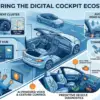
A digital cockpit is an integrated vehicle interface that combines digital displays, software, connectivity and vehicle information.
Instead of relying entirely on traditional analogue gauges, modern cars can display information through configurable digital screens.
The driver may be able to see:
- Speed
- Navigation
- Vehicle warnings
- Driving information
- ADAS notifications
- Energy consumption
- Media information
- Connected services
This creates a more flexible interface than traditional gauges.
Larger Screens Are Becoming Common
One of the most visible trends is the growth in display size.
Automotive manufacturers are increasingly using large central infotainment screens and digital instrument clusters.
Premium vehicles are moving toward wide or pillar-to-pillar displays.
However, larger does not automatically mean better.
A good automotive display must be readable, responsive and easy to operate while driving.
Information should also be organized so that important alerts are not buried under entertainment functions.
Research published in 2026 highlights growing demand for larger displays, immersive cockpit architectures, OLED and other advanced display technologies, along with increasing use of HUDs and passenger screens.
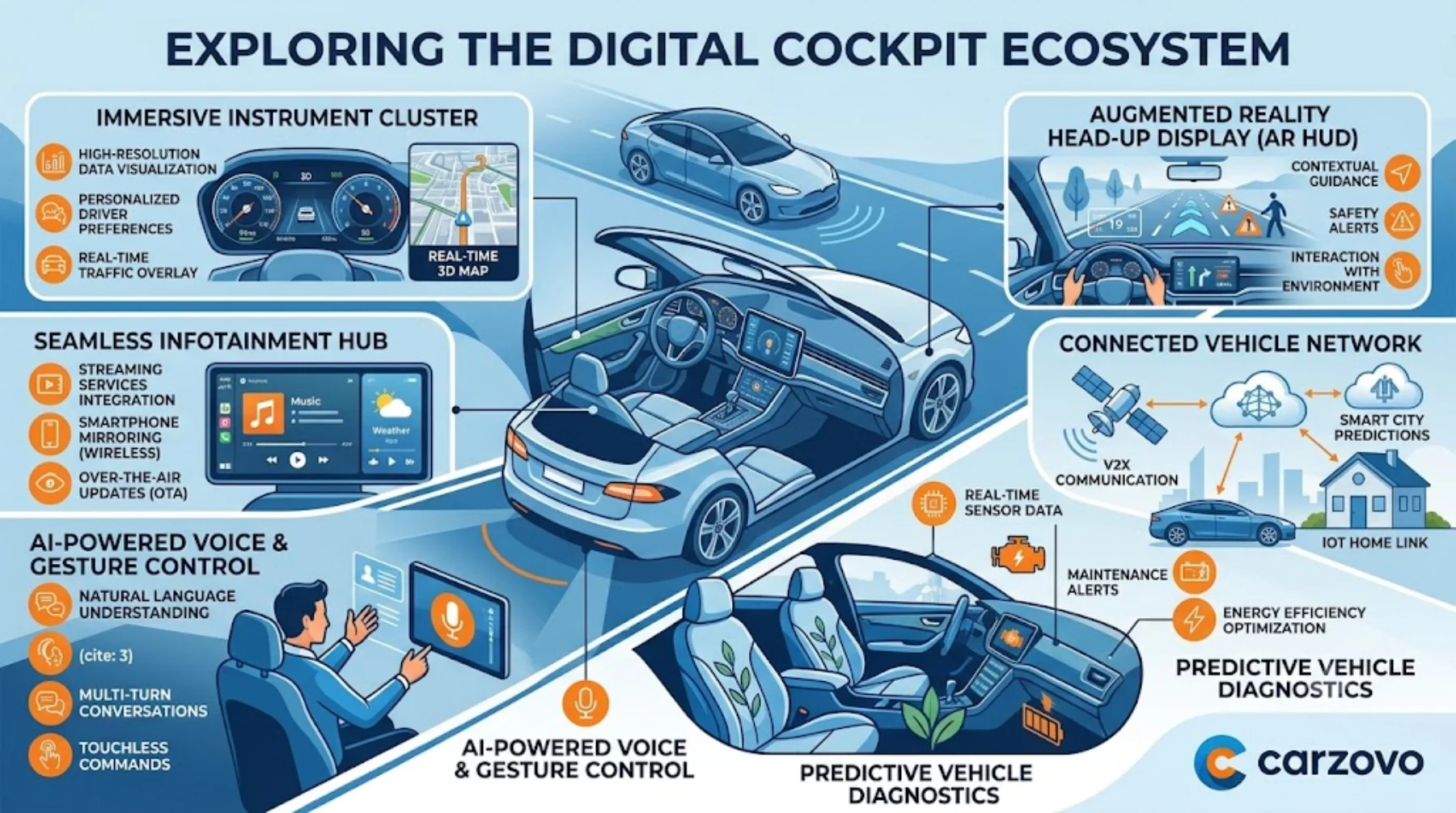
Digital Instrument Clusters
The digital instrument cluster is one of the simplest examples of cockpit transformation.
Instead of fixed analogue gauges, the driver can receive a configurable digital display.
Different driving modes may present different information.
An EV might prioritize battery range and energy consumption.
A performance car might emphasize engine or motor performance.
An ADAS-equipped vehicle may display information related to lane assistance or adaptive cruise control.
Head-Up Displays
A head-up display, or HUD, projects information into the driver’s field of view.
The driver does not need to look down at the instrument cluster for every piece of information.
Depending on the system, the display may show:
- Speed
- Navigation directions
- Warnings
- Driver assistance information
- Traffic information
This can make important information easier to access while maintaining attention toward the road.
What Makes an AR HUD Different?
An augmented-reality head-up display goes further.
Instead of simply projecting floating information, an AR HUD can visually position information relative to the road environment.
For example, a navigation arrow can appear aligned with an upcoming turn.
A warning could appear in a location that corresponds more closely with the object or area being highlighted.
This creates a stronger connection between digital information and the physical environment.
Why AR HUDs Matter
The main purpose of AR HUD technology is not entertainment.
It is information placement.
Drivers need information, but looking away from the road creates an attention challenge.
An AR HUD can potentially present relevant information within the driver’s forward field of view.
This can reduce the need to repeatedly look down at a dashboard or central screen.
However, excessive information can have the opposite effect.
If the windshield becomes overloaded with graphics, the driver may become distracted.
Good AR design therefore depends on presenting only relevant information at the right time.
Digital Cockpit and ADAS
ADAS systems generate significant amounts of information.
A vehicle may detect:
- Vehicles ahead
- Lane markings
- Pedestrians
- Blind-spot objects
- Speed limits
- Potential collision risks
The digital cockpit becomes the interface through which these systems communicate with the driver.
For example, an adaptive cruise-control system may display the detected vehicle ahead.
Lane assistance may show lane markings.
A collision warning may provide visual and audio alerts.
The challenge is to present this information without overwhelming the driver.
Passenger Displays
Digital cockpit technology is also expanding beyond the driver.
Some premium vehicles now feature dedicated passenger displays.
Passengers can potentially access navigation information, entertainment or other digital functions while the driver focuses on driving.
This represents a shift from the traditional concept of a dashboard designed primarily for the driver.
OLED, Mini-LED and Advanced Displays
Display technology itself is evolving.
Automotive manufacturers are using different technologies depending on cost, brightness, durability and design requirements.
OLED can provide strong contrast and thin display designs.
Other display technologies can provide high brightness and durability.
Automotive screens also need to operate under challenging conditions, including direct sunlight and temperature changes.
Therefore, a consumer smartphone display and an automotive display have very different engineering requirements.
Software Is as Important as the Screen
A beautiful display is not enough.
The software behind it determines how useful the cockpit actually becomes.
A good digital cockpit should have:
- Fast response
- Clear menus
- Logical navigation
- Useful voice controls
- Easy smartphone integration
- Reliable connectivity
- Simple access to important vehicle functions
This is where software-defined vehicles and digital cockpits increasingly overlap.
The display is the visible part, but software is what makes it intelligent.
AI and the Digital Cockpit
Generative AI could become another layer of the digital cockpit.
Instead of navigating menus, users may be able to ask the vehicle for information or request certain functions using natural language.
AI could also personalize the interface according to the driver.
For example, frequently used functions could become easier to access.
The combination of AI and displays could create a cockpit that changes according to context.
The Challenge of Screen Overload
There is a growing debate around the number of screens inside vehicles.
More screens can create a premium appearance, but excessive digital interaction can also increase distraction.
A driver should not have to operate a complicated touchscreen while moving through traffic.
For safety-critical functions, physical controls may remain useful.
The future cockpit will therefore likely combine touch, voice, physical controls and head-up displays instead of relying on one interaction method.
What Indian Buyers Should Check
When evaluating a digitally advanced car, buyers should look beyond screen size.
Check:
- Display brightness
- Touch response
- Digital cluster clarity
- Navigation quality
- Voice-assistant capability
- Wireless smartphone connectivity
- HUD availability
- AR-HUD functionality
- Software update support
- ADAS integration
- Physical controls for important functions
These factors can make a greater difference to daily usability than simply having the largest screen.
The Future Dashboard
The dashboard is gradually becoming less of a collection of gauges and more of an intelligent information environment.
The driver may receive essential information through a combination of digital cluster, HUD, AR graphics, voice interaction and central display.
The passenger can receive a separate digital experience.
AI can provide conversational assistance.
ADAS can communicate warnings and driving information.
Connected services can bring cloud-based information into the cabin.
All these systems can potentially operate as one integrated digital cockpit.
From Dashboard to Digital Experience
The biggest change is not the screen itself.
It is the transformation of the relationship between driver and vehicle.
The traditional dashboard tells the driver what the vehicle is doing.
The digital cockpit can potentially understand what the driver needs and decide how information should be presented.
AR HUDs can connect digital information with the physical road.
AI can connect voice conversations with vehicle functions.
Software can connect the entire system through regular updates.
The result is an automobile interior that increasingly feels like an intelligent digital environment.
In 2026, the cockpit is no longer just the place where you see speed and fuel information.
It is becoming the primary interface between humans, software and the vehicle.