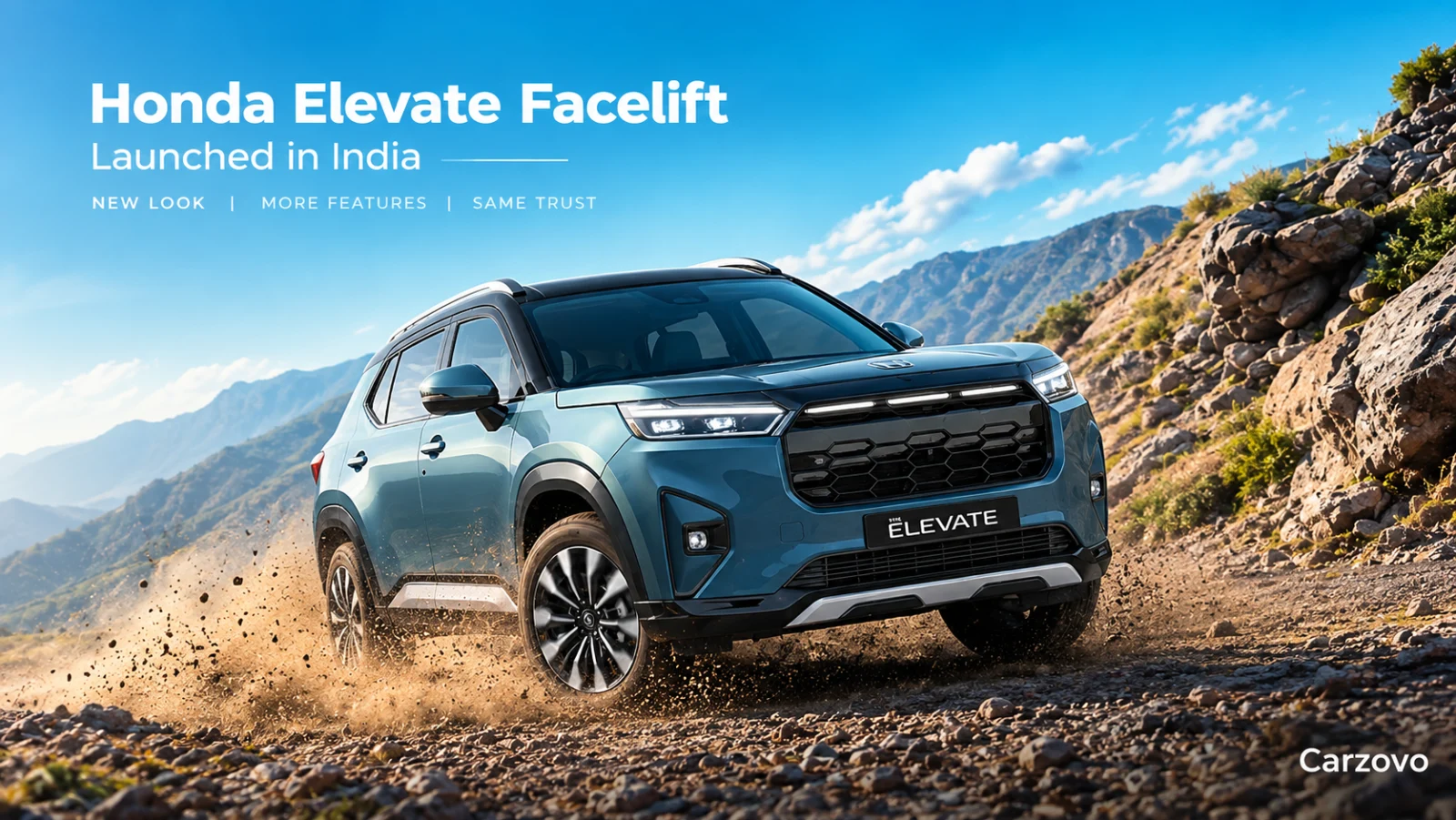
Honda has finally given its popular midsize SUV a much-needed update. The 2026 Honda Elevate facelift has been launched in India at a starting ex-showroom price of ₹11.80 lakh, marking the first major update to the SUV since its introduction in 2023.
The facelift was officially launched on October 6, 2026, with India becoming the first market globally to receive the updated Elevate. Honda had opened pre-launch bookings on October 1 with a booking amount of ₹21,000. Instead of making major mechanical changes, Honda has focused on improving the Elevate’s exterior appearance, cabin experience, comfort features, parking technology and safety equipment.
The biggest additions include front and rear ventilated seats, powered front seats, a factory-fitted 360-degree camera, front parking sensors, electronic parking brake with auto-hold, a connected LED rear light signature and upgraded Honda Sensing functionality.
At the same time, Honda has retained the familiar 1.5-litre naturally aspirated petrol engine with both manual and CVT transmission options.
2026 Honda Elevate Facelift Price in India
The new Honda Elevate is available in five main grades: SV, V, VX, ZX and ZX+. Honda has also introduced a ZX+ Black version at the top of the range.
The starting price remains unchanged at ₹11.80 lakh, but the facelift introduces additional equipment and a new top-end trim.
| Variant | Manual | CVT |
|---|---|---|
| SV | ₹11.80 lakh | — |
| V | ₹12.29 lakh | ₹13.79 lakh |
| VX | ₹13.93 lakh | ₹15.39 lakh |
| ZX | ₹15.39 lakh | ₹16.89 lakh |
| ZX+ | ₹16.80 lakh | ₹18.30 lakh |
| ZX+ Black | ₹16.90 lakh | ₹18.40 lakh |
All prices are ex-showroom Delhi/introductory prices. Pearl and certain dual-tone colour combinations may attract additional charges.
The important point is that Honda has kept the entry price unchanged while expanding the upper end of the range. The new ZX+ and ZX+ Black trims push the maximum price to ₹18.40 lakh for the CVT version.
Compared with the outgoing model, the top-end price has increased significantly, but buyers also get considerably more equipment in return.
Honda Elevate Facelift Gets a New Exterior Design
The 2026 Honda Elevate facelift does not completely redesign the SUV. Instead, Honda has concentrated on the areas that make the biggest visual difference.
The front-end is now more distinctive, with a new mesh grille finished in gloss black. The Honda badge has also moved from the grille area to the leading edge of the bonnet.
Above the grille, Honda has added new tri-bar LED position lights, giving the SUV a more modern lighting signature.
The main LED headlamp units continue to retain the basic Elevate design, but the surrounding lighting treatment makes the front look considerably newer.
The lower portions of the front bumper, wheel arches and fenders also receive gloss-black treatment. The updated roof rails and darker exterior elements give the SUV a slightly sportier appearance.
The alloy wheels have also been updated to 17-inch Berlina Black dual-tone units with a dark-clear finish, adding to the facelift’s more premium appearance.
New Connected LED Tail Lamps
At the rear, the biggest visual change is the new connected LED tail-lamp treatment.
A horizontal LED light signature visually links the rear lamps across the tailgate, making the Elevate look wider and more contemporary.
The rear bumper also receives gloss-black detailing.
The overall body shape, however, remains familiar. Honda has deliberately avoided turning the facelift into an entirely new-generation SUV.
New Nordic Forest Pearl Colour
Honda has also introduced a new Nordic Forest Pearl colour for the updated Elevate.
It is available as both a single-tone colour and with a black roof in dual-tone form.
Other colour choices include:
- Obsidian Blue Pearl
- Lunar Silver Metallic
- Meteoroid Grey Metallic
- Crystal Black Pearl
- Radiant Red Metallic
- Platinum White Pearl
- Nordic Forest Pearl
Radiant Red Metallic and Platinum White Pearl can also be selected with a black roof, while Nordic Forest Pearl adds a fresh alternative to the colour palette.
More Premium Interior for the 2026 Honda Elevate
Honda has made more substantial changes inside the cabin than the exterior might initially suggest.
The facelift gets a dual-tone ivory-and-black interior theme, along with soft-touch elements and additional gloss-black detailing.
The ZX+ Black version gets an all-black interior theme.
One of the most noticeable additions is wraparound Active Orange ambient lighting, which gives the cabin a more premium appearance at night.
The air-conditioning vents also receive piano-black treatment, while LED cabin lighting has been added.
Honda has also upgraded the seating arrangement significantly.
Ventilated Front and Rear Seats
One of the biggest talking points of the new Elevate is its ventilated seating.
The facelift introduces front ventilated seats from the ZX trim, while rear-seat ventilation is reserved for the ZX+ trim.
The rear ventilation feature is particularly notable because it is being positioned as a segment-first feature. This could make the Elevate more attractive to buyers who regularly travel with rear-seat passengers, especially in India’s hot climate.
Honda has also introduced powered front seats.
The top-spec ZX+ gets an 8-way electrically adjustable driver’s seat and a 4-way electrically adjustable front passenger seat.
This is a substantial upgrade over the outgoing Elevate, which lacked powered front-seat adjustment.
The combination of powered front seats and front and rear ventilation makes the top variant considerably more premium than before.
Electronic Parking Brake and Auto Hold
Another important cabin-related change is the replacement of the conventional manual handbrake.
The 2026 Elevate now gets an electronic parking brake with auto-hold.
This makes the centre console cleaner and brings the Elevate closer to newer competitors that have already adopted electronic parking brakes.
Auto-hold can be particularly useful in city traffic because the system can hold the vehicle stationary without requiring the driver to continuously keep the brake pedal pressed.
360-Degree Camera Finally Comes to the Elevate
The older Honda Elevate was criticised for not having a factory-fitted 360-degree camera.
Honda has addressed this with the facelift.
The new Elevate gets a 360-degree surround-view camera, although the feature is reserved for the top-spec ZX+ variants. Front parking sensors are also included with the top trim.
The system should make parking and manoeuvring in tight urban spaces considerably easier.
The SUV also retains its rear-view camera, guidelines and Honda’s LaneWatch functionality.
This is one of the most meaningful upgrades because the 360-degree camera has become an increasingly expected feature in the midsize SUV segment.
Updated Infotainment and Digital Instrumentation
The 2026 Elevate continues with a 10.25-inch HD touchscreen infotainment system, now accompanied by wireless Android Auto and Apple CarPlay.
The SUV also receives a 7-inch HD TFT-based instrument display with a digital-analogue layout.
Other technology additions include:
- Front and rear USB Type-C ports
- PM2.5 air-quality display
- Wireless smartphone connectivity
- Rear-view camera with guidelines
- LaneWatch camera functionality
- Updated cabin lighting
The infotainment screen size itself is not dramatically different from the outgoing model, but Honda has improved the overall technology package around it.
Honda Sensing ADAS Gets an Important Update
Honda has retained its Honda Sensing ADAS package on the updated Elevate.
The SUV continues to offer advanced safety technologies such as adaptive cruise control, lane-keeping assistance and collision-mitigation functions.
One important improvement is the addition of low-speed follow functionality to adaptive cruise control on CVT variants.
This should make the system more useful in slower highway traffic and congested conditions.
The Elevate also continues to offer ISOFIX child-seat mounts and other standard safety equipment.
The facelift therefore does not simply add cosmetic features; it improves some of the technologies that buyers increasingly expect from a modern midsize SUV.
Honda Elevate Facelift Engine and Performance
Mechanically, Honda has taken a conservative approach.
The 2026 Elevate continues to use the familiar 1.5-litre, four-cylinder naturally aspirated i-VTEC petrol engine.
It produces approximately 121 PS and 145 Nm, with the engine paired with either a 6-speed manual transmission or a 7-step CVT automatic.
The claimed fuel efficiency remains around:
- 15.31 kmpl – Manual
- 16.92 kmpl – CVT
The front-wheel-drive layout is retained.
This means there is no turbo-petrol engine and no hybrid powertrain with the facelift.
For buyers who appreciate Honda’s naturally aspirated petrol engine for its linear power delivery and relatively straightforward mechanical layout, this is a positive.
However, the lack of a hybrid option is also one of the biggest talking points surrounding the facelift.
No Hybrid Engine: The Biggest Miss?
The Elevate facelift arrives at a time when hybrid powertrains have become increasingly important in India’s midsize SUV segment.
Rivals such as the Toyota Urban Cruiser Hyryder and Maruti Suzuki Grand Vitara offer strong-hybrid options.
The Honda City is also available with Honda’s hybrid technology.
Yet the Elevate facelift continues exclusively with the naturally aspirated petrol engine.
This decision may disappoint buyers looking for high fuel efficiency and a more electrified driving experience.
The Team-BHP discussion following the launch also reflects this sentiment. Several enthusiasts welcomed the feature upgrades but pointed out that a hybrid or turbo-petrol option could have made the Elevate even more competitive.
Honda appears to have chosen a lower-complexity route for this facelift, concentrating investment on equipment and design rather than changing the powertrain.
Honda Elevate Facelift and NVH Improvements
Another area Honda has reportedly worked on is NVH, or noise, vibration and harshness.
The outgoing Elevate was generally appreciated for its engine, steering and ride quality, but cabin noise insulation was one of the areas that received criticism from some owners.
The facelift introduces additional sound-deadening measures around the wheel arches, instrument-panel area and wheel wells.
The objective is to make the cabin quieter and more comfortable, particularly at highway speeds. Autocar India reports that Honda has specifically addressed sound insulation as part of the update.
If these improvements are noticeable in real-world driving, they could make the new Elevate more appealing to customers who regularly undertake long highway journeys.
Dimensions and Practicality Remain Familiar
Honda has not fundamentally changed the Elevate’s dimensions.
The SUV continues with a 2,650 mm wheelbase and approximately 220 mm of ground clearance, while boot capacity remains around 458 litres.
This means the facelift retains the practical characteristics that were already strengths of the Elevate.
The higher ground clearance is useful for Indian roads, while the relatively large boot makes the SUV suitable for family travel.
Honda has therefore followed a familiar facelift formula: retain the successful underlying package and improve the areas where customers wanted more equipment.
2026 Honda Elevate Variant Strategy
The variant lineup is now broader than before.
The SV remains the entry point and is available only with the manual transmission.
The V, VX, ZX and ZX+ trims can be selected with either manual or CVT automatic transmission, while the ZX+ Black is available with both transmission options.
The top-end ZX+ is particularly important because it brings together the most significant new equipment.
The feature distribution means buyers looking for the 360-degree camera, powered front seats and rear-seat ventilation need to move toward the top of the range.
This could make the ZX+ attractive for feature-conscious buyers, although its ₹18.30 lakh starting price for the CVT and ₹18.40 lakh for the Black CVT takes it into a highly competitive part of the midsize SUV market.
2026 Honda Elevate Facelift vs Rivals
The updated Elevate continues to compete against some of India’s strongest midsize SUVs.
Its key rivals include:
- Hyundai Creta
- Kia Seltos
- Maruti Suzuki Grand Vitara
- Toyota Urban Cruiser Hyryder
- Maruti Suzuki Victoris
- Volkswagen Taigun
- Skoda Kushaq
- Renault Duster
- MG Astor
- Tata Sierra
The competition is becoming tougher because buyers now expect not only good engines and space but also connected technology, premium interiors, ADAS, multiple powertrains and advanced parking assistance.
The facelift helps the Elevate close some of the feature gap.
The 360-degree camera, ventilated front and rear seats, powered front seats and upgraded cabin are particularly important additions.
However, the lack of a hybrid or turbo-petrol option means Honda still does not match every powertrain choice available from competitors.
What the 2026 Honda Elevate Facelift Still Misses
Despite the improvements, Honda has not addressed everything.
The biggest omissions include:
No hybrid powertrain: This remains one of the most obvious gaps against hybrid-equipped rivals.
No turbo-petrol engine: Buyers looking for stronger turbocharged performance still have alternatives elsewhere.
No panoramic sunroof: The Elevate retains a single-pane electric sunroof, while several rivals offer larger panoramic units.
Limited top-end feature distribution: Some of the most desirable additions, including the 360-degree camera and rear-seat ventilation, are concentrated in the ZX+.
No major exterior redesign: Buyers expecting an entirely new-looking SUV may find the facelift relatively evolutionary.
These omissions do not necessarily make the Elevate a poor choice, but they show that Honda has prioritised sensible upgrades rather than trying to win the segment purely through a feature list.
Is the New Honda Elevate Facelift Worth Buying?
The answer depends heavily on what you want from a midsize SUV.
The 2026 Honda Elevate facelift makes considerably more sense for buyers who already liked the original Elevate but wanted better equipment.
The addition of a 360-degree camera, ventilated seats, powered front seats, electronic parking brake, improved cabin design and updated ADAS functionality directly addresses several areas where the original model felt behind its rivals.
The unchanged naturally aspirated engine can also be considered an advantage for buyers who prefer a familiar petrol powertrain instead of chasing maximum performance.
For highway users, the manual and CVT choices continue to provide flexibility.
The bigger question is whether buyers will accept the lack of a hybrid option when fuel efficiency is becoming increasingly important.
Final Verdict on the 2026 Honda Elevate Facelift
The 2026 Honda Elevate facelift is not an all-new SUV, but it is a much more complete version of the original Elevate.
Honda has kept the proven 1.5-litre petrol engine and familiar dimensions while concentrating on the areas that matter most to today’s buyers.
The exterior receives a sharper grille, new LED lighting signatures, connected rear lamps, darker styling elements and a new Nordic Forest Pearl colour.
Inside, the changes are more meaningful. The premium ivory-black cabin, ambient lighting, powered front seats and ventilation functions give the Elevate a considerably more upmarket feel.
The 360-degree camera, front parking sensors, electronic parking brake and improved adaptive cruise-control functionality make the SUV better equipped for modern driving.
The starting price of ₹11.80 lakh is also important because Honda has managed to retain the previous entry-level price despite adding equipment. The new top-end ZX+ Black CVT reaches ₹18.40 lakh ex-showroom, giving customers a much more feature-rich flagship than before.
The biggest unanswered question remains the powertrain.
Honda has improved almost everything around the engine but has not introduced a hybrid or turbo-petrol option.
Still, for buyers looking for a comfortable, naturally aspirated petrol midsize SUV with strong ground clearance, improved safety technology, better cabin comfort and Honda’s familiar driving character, the facelifted Elevate has become a much stronger proposition.
The 2026 update may not completely transform Honda’s position in the Indian SUV market, but it addresses many of the complaints surrounding the original Elevate and gives the model a much better chance of competing with India’s increasingly feature-rich midsize SUV segment.