The Tata Nexon EV continues to be one of India’s most popular choices among buyers looking for a practical electric SUV. Its compact dimensions, familiar SUV design, strong equipment list and relatively accessible pricing have made it an important model in India’s EV market.
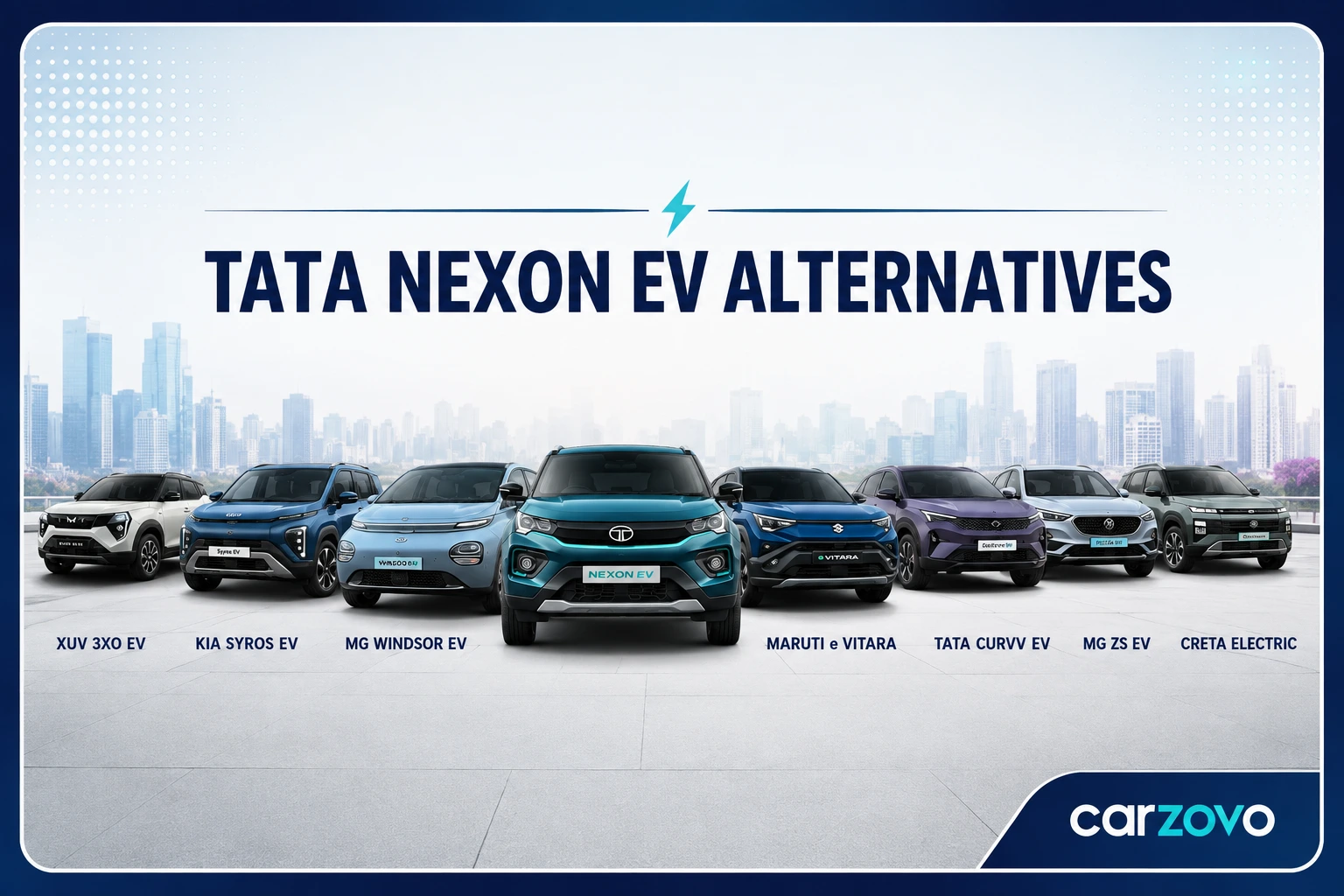
However, the electric SUV market has changed considerably in 2026. Buyers now have more choices at almost every price point. The Mahindra XUV 3XO EV, MG Windsor EV, Kia Syros EV, Maruti Suzuki e Vitara, MG ZS EV, Tata Curvv EV and Hyundai Creta Electric all compete with the Nexon EV in different ways.
The Nexon EV remains particularly attractive because its 45kWh version offers a claimed MIDC range of up to 489km, while the 30kWh version provides a lower entry point into Tata’s electric SUV range. Its single-motor front-wheel-drive setup produces up to 142hp and 215Nm.
But which car should you choose if you are considering something other than the Nexon EV?
Tata Nexon EV vs Its Main Alternatives
| Electric SUV | Approx. Ex-Showroom Price | Battery | Claimed Range | Best For |
|---|---|---|---|---|
| Tata Nexon EV | ₹12.49–17.69 lakh | 30kWh, 45kWh | Up to 489km | Overall value |
| Mahindra XUV 3XO EV | ₹13.89–14.96 lakh | 39.4kWh | 351km | Performance |
| Kia Syros EV | ₹13.50–20.00 lakh | 42kWh, 51.4kWh | Up to 526km | Features & range |
| MG Windsor EV | ₹14.10–18.60 lakh | 38kWh, 52.9kWh | Up to 449km | Cabin comfort |
| Maruti e Vitara | ₹16.19–19.99 lakh | 49kWh, 61kWh | Up to 543km | Range & practicality |
| Tata Curvv EV | Around ₹17 lakh onwards | 45kWh, 55kWh | Up to 502km | Styling & boot space |
| MG ZS EV | ₹17.99–20.50 lakh | 50.3kWh | 461km | Premium experience |
| Hyundai Creta Electric | ₹18 lakh onwards | 42kWh, 51.4kWh | Up to 510km | Premium family SUV |
Prices and specifications can vary according to variant and manufacturer updates.
1. Mahindra XUV 3XO EV

The Mahindra XUV 3XO EV is one of the closest alternatives to the Nexon EV because of its pricing and compact SUV positioning. It is essentially the electric version of the XUV 3XO and has become Mahindra’s most affordable EV.
It uses a 39.4kWh battery paired with a front-mounted electric motor producing 150hp and 310Nm. Mahindra claims a MIDC range of 351km, while the 0-100km/h acceleration time is claimed at 8.3 seconds.
The biggest advantage of the XUV 3XO EV is performance. Its 310Nm of torque is considerably higher than the Nexon EV 45’s 215Nm. Higher variants also bring equipment such as Level 2 ADAS, a 360-degree camera, panoramic sunroof, dual displays and premium audio.
Its biggest weakness compared with the Nexon EV is range. The 351km claimed figure is considerably lower than the Nexon EV 45’s 489km.
Choose XUV 3XO EV if: performance, acceleration and advanced driver-assistance features are more important to you than maximum range.
2. Kia Syros EV
The Kia Syros EV is one of the most important new additions to this segment in 2026. It directly challenges the Nexon EV and XUV 3XO EV while offering a strong combination of features and range.
Kia offers the Syros EV with 42kWh and 51.4kWh battery packs. The larger battery provides a claimed range of 526km, while the 42kWh version is rated at 443km. Power output is 135hp with the smaller battery and 171hp with the larger battery.
The Syros EV also focuses heavily on cabin comfort. Its compact exterior hides a surprisingly versatile cabin with sliding and reclining rear seats, making it an interesting choice for families.
The pricing starts at ₹13.50 lakh and goes up to ₹20 lakh ex-showroom. Kia also offers a BaaS ownership option, which can reduce the upfront vehicle price while adding a battery usage charge.
Choose Syros EV if: you want a compact electric SUV with strong features, a long-range option and a premium-feeling cabin.
3. MG Windsor EV

The MG Windsor EV takes a different approach from the Nexon EV. Rather than focusing primarily on SUV styling, MG has designed the Windsor around interior space and passenger comfort.
It is available with 38kWh and 52.9kWh battery packs. The larger Windsor Pro offers a claimed range of 449km, while the standard 38kWh version is rated at 332km.
The Windsor’s 2,700mm wheelbase contributes to its spacious cabin. Its reclining rear seats are particularly appealing to passengers who spend a lot of time in the back.
The Windsor also offers a large 15.6-inch touchscreen, panoramic glass roof, ventilated seats, premium audio and advanced safety equipment on higher variants.
Choose Windsor EV if: rear-seat comfort, interior space and a relaxed family-car experience are your priorities.
4. Maruti Suzuki e Vitara

The Maruti Suzuki e Vitara has significantly expanded the choices available to Nexon EV buyers. It is positioned as a larger electric SUV and brings Maruti Suzuki’s extensive Indian ownership network into the EV space.
The e Vitara comes with 49kWh and 61kWh battery options. The smaller battery has a claimed 440km range, while the 61kWh version offers up to 543km under the MIDC cycle.
The larger battery and bigger SUV proportions make the e Vitara especially interesting for buyers who regularly travel longer distances.
Maruti also offers a battery subscription arrangement on selected versions, allowing the initial vehicle price to be reduced by separating the battery cost from the vehicle purchase.
Choose e Vitara if: you want a larger SUV, longer claimed range and the convenience of Maruti Suzuki’s established ownership network.
5. Tata Curvv EV

The Tata Curvv EV is the natural upgrade for buyers who like the Nexon EV but want something larger and more distinctive.
Its coupe-SUV design gives it significantly more road presence than the Nexon EV. Depending on the variant, the Curvv EV offers larger battery options and a claimed range of up to around 500km.
Its larger boot and more spacious cabin make it better suited to families who frequently travel with luggage.
Because it shares Tata’s EV ecosystem, Nexon EV buyers considering an upgrade can remain within the same brand.
Choose Curvv EV if: you want to upgrade from the Nexon EV without leaving Tata’s electric vehicle ecosystem.
The MG ZS EV sits above the Nexon EV in terms of pricing and positioning. It is larger, more powerful and offers a more premium experience.
The ZS EV uses a 50.3kWh battery with a 177hp electric motor producing 280Nm. Its claimed range is 461km.
Its 4,323mm length and 470-litre boot make it considerably more practical for buyers who need additional luggage space.
The ZS EV also offers features such as a panoramic sunroof, powered driver’s seat, 360-degree camera, connected technology and wireless charging.
However, its starting price of ₹17.99 lakh puts it well above the entry-level Nexon EV.
Choose ZS EV if: you want more power, space and premium equipment and are comfortable with a higher budget.
7. Hyundai Creta Electric
The Hyundai Creta Electric is another alternative for buyers willing to move into a higher price bracket.
It combines the familiar Creta’s family-friendly dimensions with an electric powertrain. Its battery options include 42kWh and 51.4kWh units, with the larger version offering a claimed range of around 510km.
The Creta Electric focuses on comfort, technology and premium cabin quality, making it more suitable for buyers who use their EV as a primary family vehicle.
It is not a direct budget competitor to the Nexon EV, but higher Nexon EV variants can overlap with entry-level versions of larger electric SUVs.
Choose Creta Electric if: you want a premium family SUV and have a larger EV budget.
Tata Nexon EV or Its Alternative: The Verdict
The Tata Nexon EV has not become a bad choice simply because more EVs have entered the market. Instead, buyers now have more ways to choose according to their priorities.
The Nexon EV remains the best all-round value proposition for buyers who want a compact electric SUV with a strong combination of price, range, equipment and city-friendly dimensions.
The Mahindra XUV 3XO EV is better for performance, the Kia Syros EV brings a compelling combination of technology and range, while the MG Windsor EV is the better option for rear-seat comfort.
The Maruti e Vitara is particularly attractive for buyers looking for a larger SUV and longer claimed range. Meanwhile, the MG ZS EV, Tata Curvv EV and Hyundai Creta Electric make more sense when the budget moves toward premium electric SUVs.
In 2026, the question is therefore no longer simply “Is the Nexon EV the best EV?” The better question is “Which EV fits your driving requirements, budget and charging needs?”
And that is exactly where the growing number of Tata Nexon EV alternatives gives buyers a major advantage.