The Future of Driving in India-
The automobile industry is undergoing one of its biggest transformations since the invention of the internal combustion engine. Cars are no longer just mechanical machines designed to take people from one place to another. They are rapidly evolving into intelligent, software-driven platforms capable of learning driver behavior, communicating with surrounding vehicles, receiving over-the-air updates, and making real-time driving decisions.
Just a decade ago, premium features meant leather seats, alloy wheels, and touchscreen infotainment systems. Today, buyers are looking for artificial intelligence, advanced driver assistance systems (ADAS), connected technology, predictive maintenance, voice-controlled functions, and even autonomous driving capabilities. Modern vehicles are becoming smarter with every software update, reducing the importance of traditional mechanical features.
As India embraces electric mobility and connected transportation, smart cars are expected to redefine what drivers expect from their vehicles. This shift will gradually replace many outdated features that have remained unchanged for decades.
The Shift from Mechanical Cars to Software-Defined Vehicles
For decades, cars relied almost entirely on mechanical engineering. Once a vehicle left the factory, its capabilities remained the same throughout its lifespan. Improvements were only possible by purchasing a newer model.
Modern smart cars operate differently. Their software can be updated remotely, allowing manufacturers to introduce new features, improve performance, fix security vulnerabilities, and enhance the driving experience without requiring a visit to the service center.
This software-first approach has transformed cars into evolving products rather than static machines. It also enables manufacturers to continuously improve safety systems, infotainment interfaces, battery management, and energy efficiency long after the vehicle has been delivered.
Artificial Intelligence Is Becoming the New Co-Driver
Artificial intelligence is playing an increasingly important role in the automotive industry. Instead of simply responding to driver inputs, modern vehicles can analyze road conditions, monitor traffic, recognize obstacles, and predict potential hazards.
AI-powered systems are already capable of understanding voice commands, recommending efficient driving routes, monitoring driver fatigue, and optimizing battery usage in electric vehicles. As computing power improves, future smart cars will become even more capable of assisting drivers in complex traffic situations.
Rather than replacing the driver immediately, artificial intelligence is evolving into a trusted co-driver that improves convenience and safety.
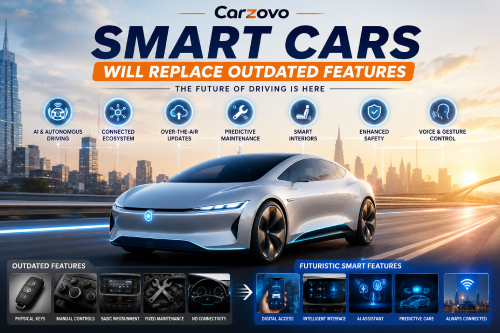
Traditional Keys Will Soon Become Obsolete
One of the simplest yet most noticeable changes is the disappearance of the traditional car key.
Many modern vehicles already allow owners to unlock, start, and monitor their cars using smartphones or smartwatches. Digital keys can be securely shared with family members, eliminating the need for duplicate physical keys.
Biometric authentication, including facial recognition and fingerprint verification, is also beginning to appear in premium vehicles. These technologies will eventually make traditional keys unnecessary.
Physical Buttons Are Giving Way to Intelligent Interfaces
Car interiors are becoming cleaner and more intuitive. Large touchscreen displays, voice assistants, gesture controls, and customizable digital dashboards are gradually replacing dozens of physical switches.
Instead of searching for a button while driving, users can simply say, “Increase cabin temperature,” “Open the sunroof,” or “Navigate to the nearest charging station.”
Future interfaces will rely even more on natural language processing, allowing conversations with the vehicle to feel almost human.
Predictive Maintenance Will Replace Routine Guesswork
Traditional vehicle maintenance relies on fixed service intervals, regardless of how the vehicle has actually been driven.
Smart cars continuously monitor hundreds of sensors that track battery health, engine performance, brake wear, tire condition, and cooling systems. Using predictive analytics, the vehicle can warn owners about potential failures before they become expensive repairs.
This approach reduces unexpected breakdowns, lowers maintenance costs, and improves long-term reliability.
Navigation Is Becoming Context-Aware
Conventional GPS systems simply provide directions.
Future navigation systems will consider weather conditions, traffic density, charging availability, driver preferences, parking occupancy, and even energy consumption before recommending the most efficient route.
Electric vehicles already use intelligent route planning to calculate charging stops automatically. As infrastructure improves, these systems will become even more accurate and efficient.
Connected Cars Will Communicate with Everything
One of the biggest changes coming to the automotive industry is Vehicle-to-Everything (V2X) communication.
Instead of operating independently, future vehicles will exchange information with traffic signals, road infrastructure, nearby vehicles, emergency services, and cloud-based traffic management systems.
Imagine receiving an alert about an accident around a blind corner before it becomes visible, or a traffic signal communicating the optimal speed to avoid unnecessary stops. These technologies have the potential to reduce congestion and improve road safety.
Over-the-Air Updates Will Keep Cars New for Years
Traditionally, buying a newer model was the only way to access updated features.
Software-defined vehicles change this completely. Manufacturers can deliver new capabilities through secure over-the-air updates, improving infotainment systems, adding driving modes, enhancing battery efficiency, or refining ADAS performance without replacing the vehicle.
This approach extends the useful life of a car and provides owners with continuous improvements over time.
Safety Systems Are Becoming Proactive
Older safety technologies primarily focused on protecting occupants during a collision.
Modern smart cars aim to prevent accidents before they occur. Cameras, radar, ultrasonic sensors, and artificial intelligence continuously monitor the surrounding environment.
Features such as adaptive cruise control, lane centering, automatic emergency braking, blind-spot monitoring, and collision avoidance are already becoming common. Future systems will become even more predictive as sensor technology and AI continue to evolve.
Personalization Will Redefine the Driving Experience
Future vehicles will recognize individual drivers and automatically adjust seating positions, mirrors, climate settings, navigation preferences, ambient lighting, music playlists, and driving modes.
Cloud-based driver profiles will allow these preferences to follow users across multiple compatible vehicles, creating a highly personalized ownership experience.
Cars will no longer feel like identical machines but rather intelligent companions that adapt to individual lifestyles.
Challenges That Still Need to Be Solved
Although the future is promising, smart cars also introduce new challenges.
Cybersecurity will become increasingly important as vehicles become more connected. Manufacturers must ensure that software systems remain protected from hacking attempts and unauthorized access.
Data privacy is another major concern. Smart cars generate enormous amounts of information, making transparent data management policies essential for maintaining consumer trust.
India must also continue expanding its digital infrastructure, high-speed connectivity, charging networks, and intelligent road systems to fully support next-generation mobility.
What This Means for Indian Buyers
India is entering an exciting period where software, connectivity, and artificial intelligence will become just as important as horsepower and fuel efficiency.
Consumers purchasing vehicles over the next few years will increasingly evaluate software capabilities, update support, connected services, and safety technologies alongside traditional specifications.
Manufacturers that prioritize intelligent software ecosystems are likely to gain a significant competitive advantage in the Indian market.
Final Verdict
The future of the automobile is no longer defined solely by bigger engines or more luxurious interiors. Intelligence is becoming the new benchmark. Features that once represented innovation—physical keys, fixed navigation systems, mechanical dashboards, and static software—are gradually giving way to connected ecosystems powered by artificial intelligence.
While fully autonomous vehicles may still take time to become mainstream in India, the transition toward smart mobility has already begun. Every new generation of vehicles is becoming more connected, more predictive, and more capable of adapting to driver needs through software rather than hardware.
The next decade will likely witness the biggest technological revolution in automotive history, transforming cars from transportation machines into intelligent digital companions. For buyers, this means safer journeys, lower maintenance costs, continuous feature upgrades, and a driving experience that improves long after the day of purchase. This is not just the future of cars—it is the future of mobility itself.