The automobile is entering a new phase in automotive Vehicles Especially cars segment.
For decades, most vehicle improvements were closely connected to mechanical engineering. A new generation might bring a more powerful engine, better suspension, improved transmission or redesigned hardware.
Software-defined vehicles are changing this model.
The modern vehicle increasingly behaves like a connected computing platform. Software controls more vehicle functions, processes information from multiple sensors and connects the car to cloud services.
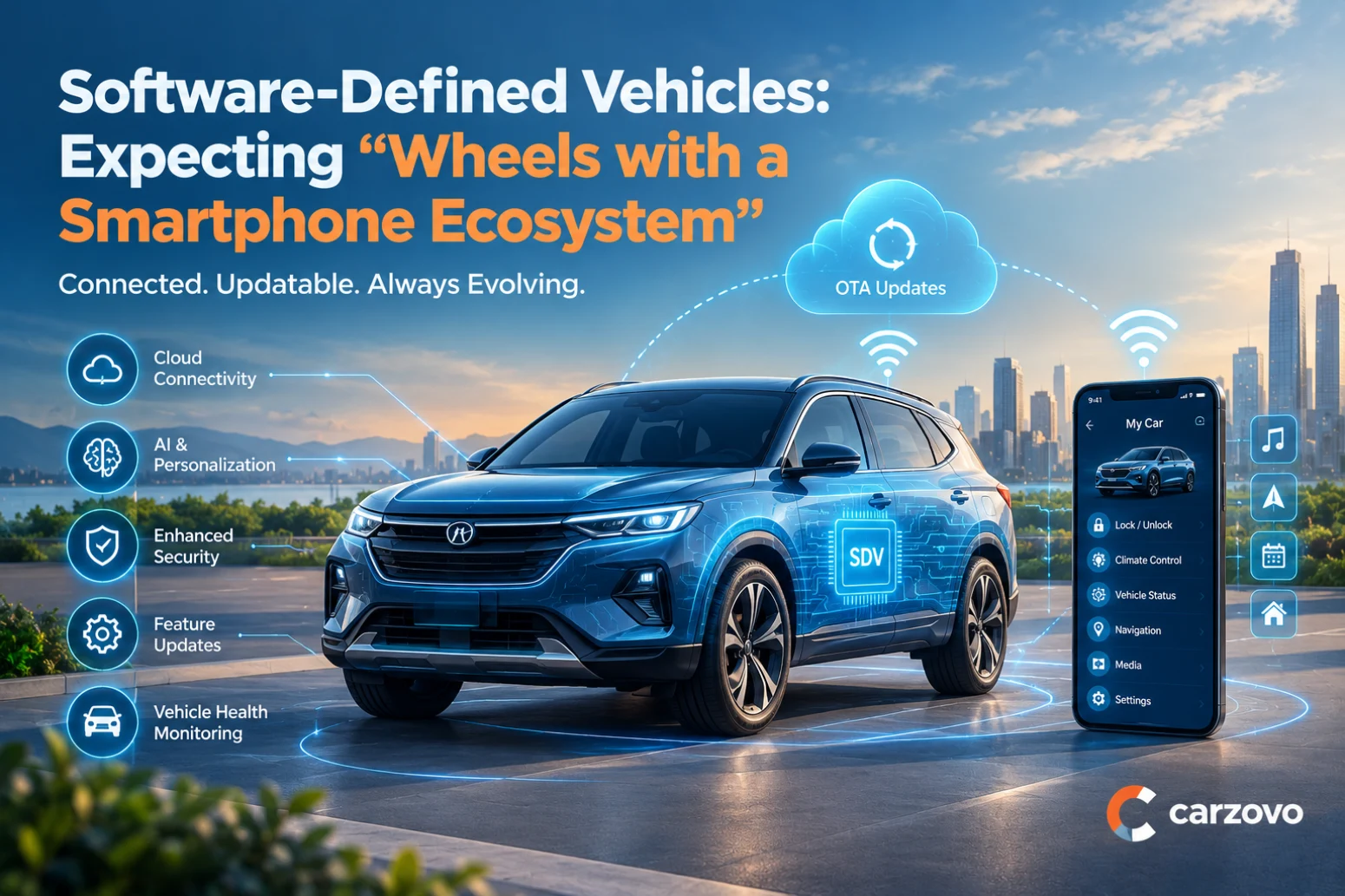
This is why the idea of a car becoming a “smartphone ecosystem on wheels” is becoming increasingly relevant.
What Is a Software-Defined Vehicle?
A Software-Defined Vehicle, commonly called an SDV, is a vehicle where software plays a central role in controlling, managing and delivering vehicle functions.
This does not mean hardware has become unimportant.
The engine, battery, brakes, steering, suspension, sensors and electronic components are still essential.
The difference is that software increasingly determines how those systems interact.
Modern SDV architectures can use centralized or zonal computing instead of relying on a large number of independent electronic control units.
The IEA describes this shift as a move from traditional distributed electronic architectures toward domain and zonal approaches with more centralized computing.
Why Are Cars Moving Toward SDVs?
One major reason is complexity.
Modern cars contain thousands of electronic components and increasingly large amounts of software.
ADAS, infotainment, connectivity, battery management, digital dashboards and vehicle personalization all require computing resources.
A software-defined architecture can provide a common platform for these functions.
It can also make future updates easier.
OTA Updates Are the Smartphone-Like Feature
One of the clearest similarities between smartphones and SDVs is over-the-air updating.
A smartphone can receive a software update while sitting at home.
A software-defined car can potentially receive certain updates in a similar way.
For example, a manufacturer could improve navigation, infotainment, vehicle settings or specific software functions without requiring a physical component replacement.
Some vehicle systems may also receive performance or safety-related software improvements when appropriate.
This creates a different ownership model.
The car purchased today does not necessarily have to remain software-identical for its entire lifetime.
Features Could Continue to Evolve
Traditional vehicle features are generally fixed when the vehicle leaves the factory.
With SDVs, certain features can potentially evolve after purchase.
This can include personalization, digital services, infotainment functions and other software-controlled capabilities.
Some manufacturers are also exploring paid digital features and subscriptions.
This creates a new relationship between the customer and the manufacturer.
The purchase is increasingly becoming the beginning of a digital relationship rather than the end of the sales process.
Centralized Computing Is Changing Vehicle Architecture
Traditional vehicles can have many ECUs dedicated to individual functions.
SDV architectures can reduce this complexity by consolidating computing functions into fewer, more powerful systems.
Zonal architecture takes the concept further by organizing vehicle electronics around physical zones.
This can reduce wiring complexity and help create a more flexible electronic architecture.
The resulting platform can be easier to update and integrate with new software.
Research published in 2026 also identifies centralized and zonal computing, OTA updates, service-oriented architectures and AI as important elements of SDV development.
AI and SDVs Are Closely Connected
Artificial intelligence can benefit from the computing architecture of an SDV.
AI can be used for driver assistance, personalization, predictive maintenance, voice interaction and energy optimization.
For example, an intelligent vehicle could learn frequently used destinations, preferred cabin settings or charging behaviour.
AI can also analyze vehicle data to identify unusual patterns.
However, safety-critical applications require considerably stronger validation than ordinary infotainment functions.
India Is Showing Strong Interest in SDVs
India is becoming an important market for connected and software-defined vehicle technology.
Deloitte’s 2026 India automotive consumer study found strong consumer interest in SDV capabilities, including safety, security and continuous vehicle-health reporting.
This is significant because Indian buyers are increasingly exposed to smartphones, connected devices and digital services.
Consumers may therefore expect similar convenience from their vehicles.
The Car Could Become a Digital Account
Imagine buying a vehicle and signing into your personal automotive profile.
The car could potentially recognize your preferred seat position, climate settings, navigation preferences and infotainment choices.
When you use another compatible vehicle, some preferences could potentially follow your digital account.
This is still developing and depends heavily on manufacturer ecosystems, but it demonstrates how automotive ownership could change.
Subscription-Based Features
Software-defined vehicles also create opportunities for subscription services.
A manufacturer may provide optional digital functions through monthly or annual plans.
These could involve navigation services, connectivity packages, enhanced personalization or other software-based functions.
However, customers should carefully understand subscription terms.
A feature being technically available does not necessarily mean it is permanently included in the purchase price.
Cybersecurity Becomes Critical
The smartphone comparison also highlights an important problem: cybersecurity.
A connected vehicle has communication interfaces, software, cloud services and digital accounts.
As the number of connected functions increases, protecting these systems becomes increasingly important.
Secure software updates, encryption, authentication, data protection and continuous security monitoring can become essential parts of automotive engineering.
What Happens When the Internet Is Unavailable?
An important question for SDVs is how much functionality depends on connectivity.
A well-designed vehicle should distinguish between cloud-dependent features and core vehicle functions.
Navigation, entertainment and connected services may depend heavily on internet access.
Critical driving functions must have appropriate local operation and safety architecture.
This distinction will become increasingly important as vehicles become more connected.
Will Every Car Become a Smartphone on Wheels?
Not exactly.car has requirements that smartphones do not.
Vehicles must operate safely under extreme temperatures, vibration, weather conditions and mechanical loads.
Their software must interact with physical systems such as braking, steering and propulsion.
Therefore, the smartphone analogy is useful for understanding the digital experience but should not be taken literally.
What Buyers Should Look For
If you are considering an SDV-style vehicle, examine:
- OTA update capability
- Software support period
- Connected services
- Data privacy policies
- Cybersecurity provisions
- Smartphone integration
- Digital cockpit quality
- ADAS capabilities
- Subscription requirements
- Battery and vehicle-health monitoring
These factors may become just as relevant as traditional specifications.
The Future of Vehicle Ownership
Software-defined vehicles could fundamentally change the relationship between drivers and manufacturers.
Instead of purchasing a fixed product, consumers may increasingly purchase a hardware platform that receives software improvements throughout its life.
The concept of “wheels with a smartphone ecosystem” captures this transition.
But the most successful SDVs will not simply have more software.
They will use software to make the vehicle safer, easier to operate, more personalized and more useful.
That is the real promise of the software-defined automobile.