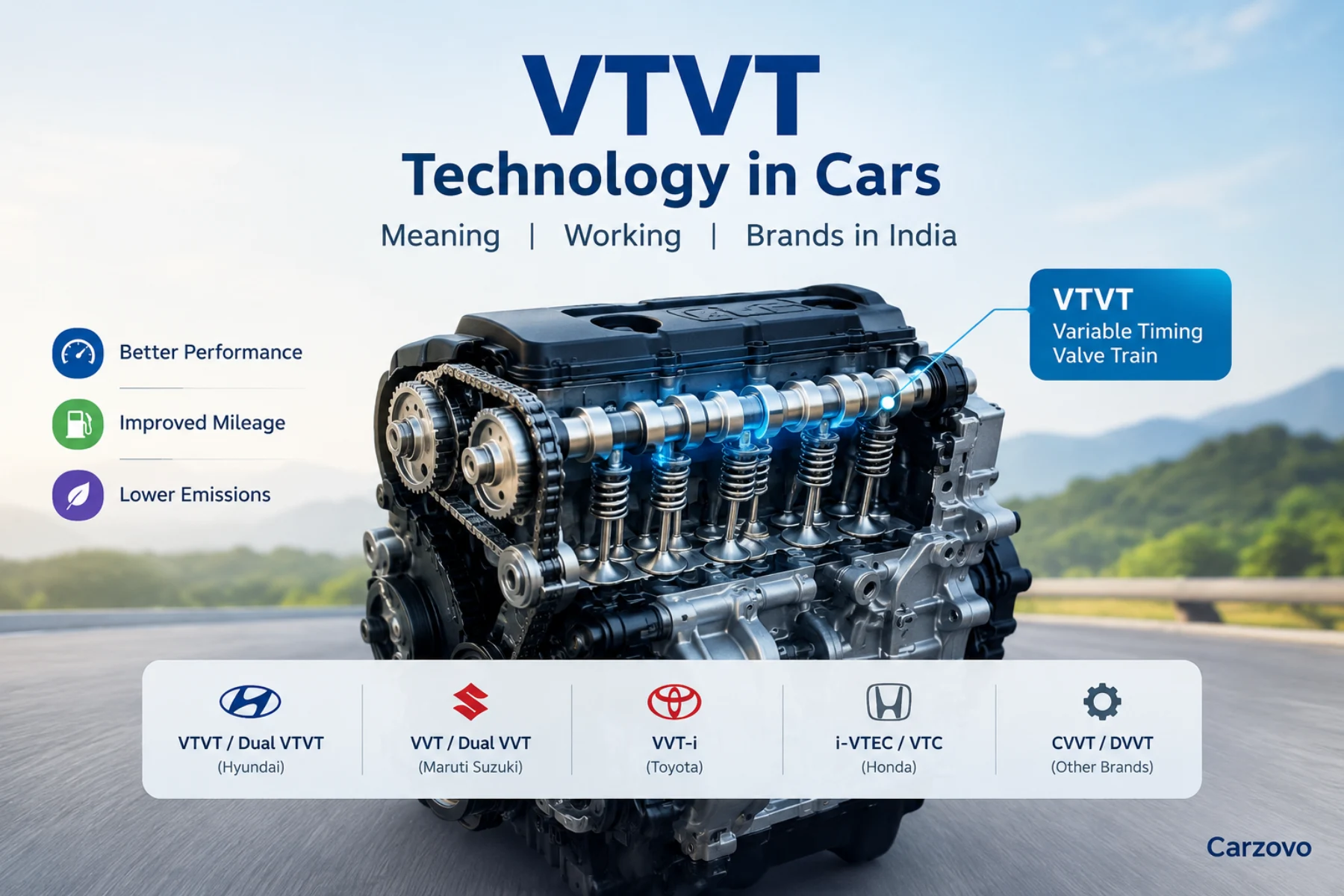
When looking at petrol car specifications, you may come across terms such as VTVT, VVT, Dual VVT, CVVT, VVT-i, i-VTEC and VTC. Although these names differ between manufacturers, many of these technologies are designed around the same basic objective: controlling engine valve timing according to driving conditions.
VTVT stands for Variable Timing Valve Train. It is an engine technology designed to alter the timing of valve operation so that the engine can balance performance, fuel efficiency and emissions more effectively.
Hyundai has specifically used the VTVT terminology for petrol engines, including its 1.2-litre Kappa engine. Other manufacturers use different names for comparable variable-valve-timing technologies.
For Indian car buyers, understanding VTVT is useful because engine technology has a direct relationship with how a petrol car performs in city traffic, highway driving and different engine-speed conditions.
What Is VTVT in a Car?
VTVT means Variable Timing Valve Train.
In a conventional petrol engine, the intake and exhaust valves operate according to a predetermined timing pattern. However, an engine does not always need the same valve timing.
At low engine speeds, the requirements are different from those at higher RPM. A variable timing system allows the engine to adjust valve operation according to its operating conditions.
The basic objective is to help the engine:
- Improve combustion efficiency
- Deliver better performance across the RPM range
- Improve fuel economy
- Reduce unnecessary emissions
- Provide smoother engine operation
Hyundai describes its VTVT system as controlling valve operation according to engine requirements, helping balance mileage, performance and emissions.
How Does VTVT Technology Work?
To understand VTVT, it is important to first understand the role of engine valves.
A four-stroke petrol engine generally operates through four stages:
- Intake
- Compression
- Power
- Exhaust
During these processes, intake and exhaust valves must open and close at carefully controlled times.
The timing of these valves affects how efficiently the engine can take in the air-fuel mixture and remove exhaust gases.
With variable valve timing, the engine can alter the timing of valve operation depending on factors such as engine speed and load.
At lower RPM, the system can use valve timing suited to smoother operation and efficiency. As engine speed increases, valve timing can be adjusted to help the engine breathe more effectively.
This is one reason variable valve timing has become an important technology in modern petrol engines.
Why Is VTVT Important for Petrol Cars?
A petrol engine has to work under many different conditions.
For example, driving slowly through a crowded Indian city requires frequent acceleration and deceleration. Highway driving requires the engine to operate for longer periods at higher speeds.
Using exactly the same valve timing in every situation is not necessarily the most efficient approach.
VTVT allows the engine to adapt valve operation to its operating requirements.
This can contribute to a useful balance between:
Mileage + Performance + Emissions + Driveability
The technology does not mean that every VTVT-equipped car will automatically deliver exceptional mileage or performance. Engine size, vehicle weight, transmission, aerodynamics, tuning, driving conditions and fuel quality also influence real-world results.
VTVT vs VVT: Are They the Same?
The terms can be confusing.
VVT stands for Variable Valve Timing, while VTVT stands for Variable Timing Valve Train.
Both refer to technologies associated with changing valve timing in an engine.
The important difference for consumers is often the manufacturer’s terminology and implementation, rather than simply the acronym.
For example, Maruti Suzuki currently describes several engines using VVT or Dual VVT, while Hyundai has used the VTVT terminology for its petrol engines.
Therefore, buyers should not assume that two engines are completely identical simply because their brochures use similar technology names.
VTVT vs Dual VTVT
You may also see the term Dual VTVT in specifications of some Hyundai petrol engines.
The word “Dual” generally indicates variable timing control involving both sides of the valve train, particularly the intake and exhaust valve timing.
Hyundai’s 1.2-litre Kappa petrol engine has been described with dual VTVT technology, with the system adjusting valve operation according to engine requirements.
The advantage of controlling valve timing more comprehensively is that the engine can be optimized over a wider range of operating conditions.
VTVT vs CVVT
Another common term is CVVT, meaning Continuously Variable Valve Timing.
The fundamental concept remains similar: valve timing is adjusted according to engine operating requirements.
The “continuously variable” description emphasizes that the timing can be adjusted over a range rather than being limited to a simple fixed change between two settings.
Car manufacturers may use different names for their systems because they have different engine designs, control strategies and proprietary technologies.
Therefore:
VTVT = Variable Timing Valve Train
CVVT = Continuously Variable Valve Timing
Both belong to the broader family of variable valve timing technologies.
VTVT vs VVT-i
Toyota is well known for its VVT-i, which stands for Variable Valve Timing-intelligent.
The concept again revolves around controlling valve timing to suit engine operating conditions.
This means VTVT and VVT-i should not be treated as completely unrelated technologies simply because the names are different.
The important point is that manufacturers develop and brand their own implementations.
Toyota’s VVT-i terminology is therefore comparable at a conceptual level with other variable valve timing systems, although the hardware and control strategy can differ between engines.
VTVT vs Honda i-VTEC
Honda uses the well-known i-VTEC technology.
Honda Cars India’s technology information explains that i-VTEC regulates intake and exhaust valve operation according to engine speed. Its current City brochure also identifies the 1.5-litre petrol engine as DOHC i-VTEC with Variable Timing Control (VTC).
This illustrates an important point for car buyers:
VTVT, VVT-i and i-VTEC are manufacturer-specific names within the broader world of variable valve-control technology.
Their exact operation should be understood from the particular engine rather than from the name alone.
VTVT Technology Across Car Brands in India
Different manufacturers have historically used different names for variable valve timing.
| Car Brand | Technology Name Commonly Seen | Basic Purpose |
|---|---|---|
| Hyundai | VTVT / Dual VTVT | Variable control of valve timing |
| Maruti Suzuki | VVT / Dual VVT | Variable valve timing |
| Toyota | VVT-i | Intelligent variable valve timing |
| Honda | i-VTEC / VTC | Variable valve control and timing |
| Other manufacturers | CVVT / DVVT / VVT variants | Variable valve timing |
The exact technology available depends on the engine and model year. Manufacturers also change engine families over time, so an older model’s specification should not automatically be applied to the latest version.
Maruti Suzuki, for example, currently lists Dual VVT technology on several K-Series petrol engines, including the K15C, K10C and other engine applications.
Which Cars Have Used VTVT Technology?
Hyundai has used VTVT technology across several petrol engine applications in India and international markets.
One notable example is the 1.2-litre Kappa petrol engine, which has been described by Hyundai with dual VTVT technology.
Older Hyundai models and engine generations have also used terminology such as Dual VTVT in their specifications.
However, car buyers should check the engine specification for the exact model year because manufacturers regularly update powertrains.
A technology name used on a previous-generation vehicle does not necessarily mean that the current-generation model uses exactly the same engine technology.
Does VTVT Increase Mileage?
VTVT can contribute to improved fuel efficiency, but it should not be considered a guaranteed mileage technology.
Fuel economy depends on many factors, including:
- Engine displacement
- Vehicle weight
- Transmission
- Driving style
- Traffic conditions
- Tyre pressure
- Air-conditioning usage
- Road conditions
- Vehicle maintenance
- Fuel quality
Variable valve timing helps the engine operate more appropriately across different conditions. This can improve efficiency compared with a less flexible valve-timing arrangement.
However, real-world mileage can still vary significantly between drivers.
Does VTVT Improve Performance?
Yes, variable valve timing can help an engine maintain better performance across different engine speeds.
An engine needs good airflow at different RPM levels. Variable valve timing allows the engine’s valve operation to be adjusted to its operating conditions.
The result can be a better balance between low-speed response, mid-range performance and high-RPM breathing.
However, VTVT alone does not determine how powerful a car will be.
A larger engine, turbocharger, compression ratio, fuel-injection system, transmission and engine calibration can all have major effects on performance.
Is VTVT Available Only in Petrol Engines?
VTVT terminology has primarily been associated with petrol engines in the Indian passenger-car market.
Variable valve timing itself is an engine technology rather than something exclusively tied to one fuel type. Modern petrol engines commonly use sophisticated valve-control systems because they can benefit from optimizing airflow and combustion across a wide RPM range.
Diesel engines can also employ sophisticated valve-control technologies, although their engine architecture and combustion requirements differ from petrol engines.
VTVT and Modern Indian Cars
The Indian automotive market has moved toward increasingly sophisticated petrol, turbo-petrol, hybrid and electric powertrains.
As a result, traditional VTVT terminology is only one part of the larger engine-technology picture.
Modern petrol engines may combine variable valve timing with:
- Multi-point fuel injection
- Direct injection
- Turbocharging
- Dual injectors
- Start-stop systems
- Exhaust-gas recirculation
- Hybrid assistance
- Advanced engine management
Maruti Suzuki, for example, combines Dual VVT with other technologies such as dual injectors, cooled EGR and Smart Hybrid systems in selected engines.
This demonstrates that variable valve timing works as one component within a complete powertrain rather than functioning as a standalone performance feature.
Is VTVT Better Than a Normal Engine?
It is more accurate to say that VTVT provides greater flexibility in controlling engine valve timing.
A conventional fixed valve-timing engine follows a more predetermined timing pattern, while a variable system can adjust valve operation according to operating conditions.
That flexibility can help engineers achieve a better compromise between efficiency, performance and emissions.
But the overall quality of an engine cannot be judged from VTVT alone.
A buyer should also consider engine displacement, power, torque, transmission, fuel economy, maintenance requirements and the vehicle’s intended usage.
What Should Indian Car Buyers Look For?
If you are comparing petrol cars, do not choose a vehicle simply because its brochure mentions VTVT, VVT, VVT-i or i-VTEC.
Instead, compare the complete powertrain.
Look at:
Engine: Check displacement, power and torque.
Transmission: Manual, AMT, CVT, torque converter or DCT can significantly change the driving experience.
Fuel efficiency: Consider both claimed and expected real-world mileage.
Maintenance: Check service requirements and long-term ownership costs.
Driving conditions: A city-focused buyer may have different priorities from someone who frequently drives on highways.
Engine refinement: Noise, vibration and smoothness can be just as important as peak power.
The Bigger Picture of VTVT Technology
VTVT is best understood as a valve-control technology designed to make an internal-combustion engine more adaptable.
Instead of relying on exactly the same valve timing under every condition, the engine can alter valve operation according to its requirements.
Hyundai’s VTVT terminology, Maruti Suzuki’s VVT and Dual VVT, Toyota’s VVT-i and Honda’s i-VTEC/VTC demonstrate how different manufacturers approach similar engineering objectives with different systems and branding.
For Indian car buyers, the key takeaway is simple: VTVT is not a transmission and should not be confused with CVT. VTVT is related to the engine’s valve timing, whereas CVT refers to a type of continuously variable transmission.
As petrol engines become more efficient and manufacturers continue combining variable valve timing with injection, turbocharging, hybrid assistance and advanced engine management, technologies such as VTVT remain an important part of the evolution of internal-combustion engines.
VTVT vs CVT: A Quick Difference
One final distinction is particularly important because the two terms are often confused.
VTVT: Variable Timing Valve Train — an engine valve-timing technology.
CVT: Continuously Variable Transmission — an automatic transmission technology.
They perform completely different functions.
VTVT affects how the engine’s valves operate.
CVT controls how engine power is transmitted to the wheels.
Therefore, a car can have variable valve timing and a CVT transmission at the same time, because the two technologies operate in different parts of the vehicle.