The Indian automobile market has changed significantly in recent years. Car buyers are no longer looking only at engine performance, mileage and exterior styling. In 2026, customers are increasingly comparing cars based on technology, safety, comfort, connectivity, convenience and overall ownership value.
With more options available across hatchbacks, sedans, SUVs, hybrids and electric vehicles, manufacturers need to offer features that provide genuine everyday benefits. A car may have a powerful engine or attractive design, but modern buyers also want a vehicle that feels technologically advanced, safe and future-ready.
For manufacturers, offering the right features can increase a model’s perceived value and help it stand out in a highly competitive market. For customers, these features can make a car more practical and satisfying to own for several years.
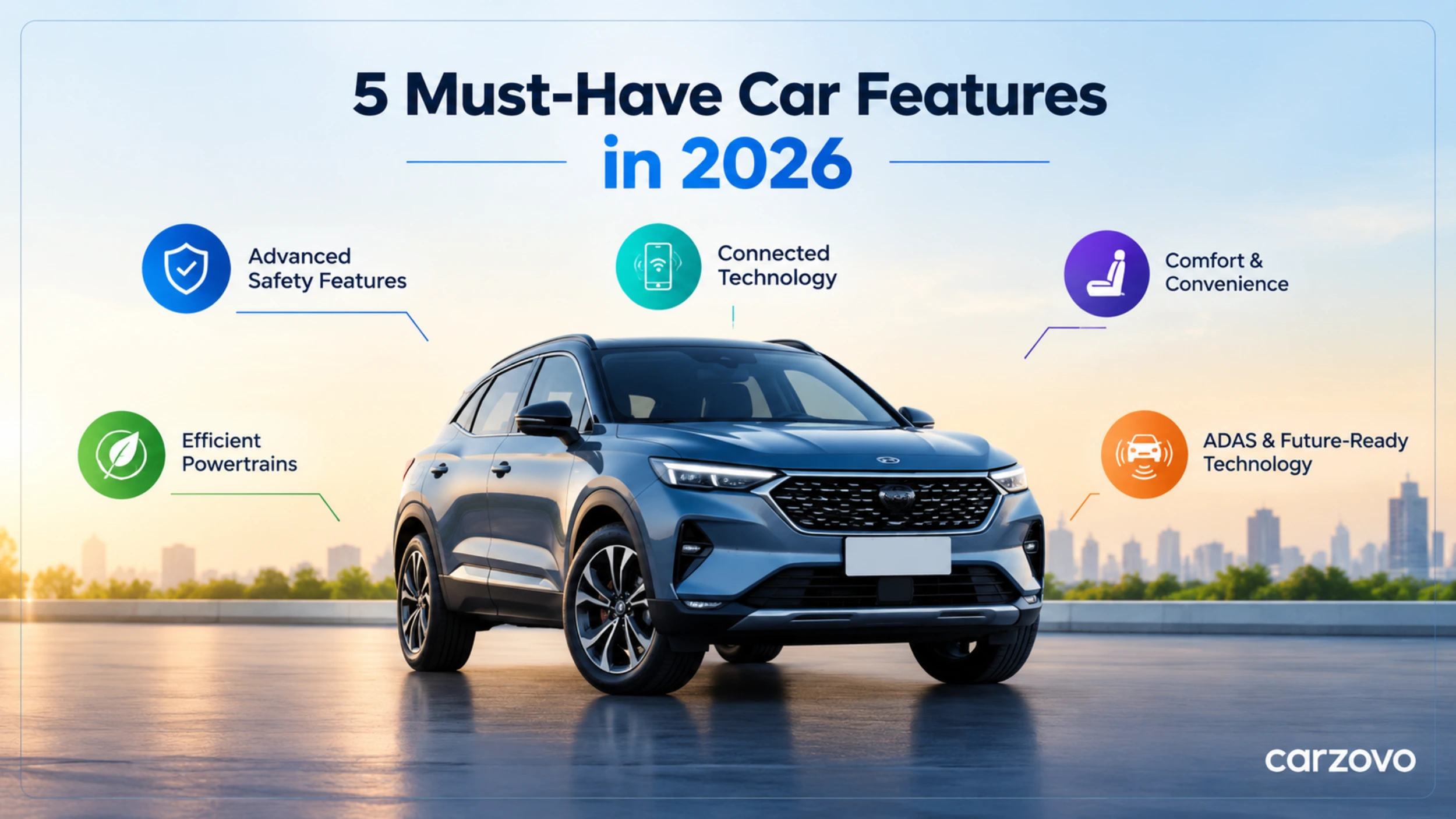
Here are five important features that every car should ideally offer in 2026 to become a stronger choice for Indian customers.
1. Advanced Safety Features Should Become Standard
Safety has become one of the most important factors influencing car-buying decisions in India. Customers are becoming more aware of crash-test ratings, airbags, electronic safety systems and driver-assistance technologies.
A modern car should therefore offer a comprehensive safety package rather than treating safety equipment as an expensive upgrade available only on higher variants.
Essential features should include multiple airbags, electronic stability control, ABS with EBD, hill-start assist, tyre-pressure monitoring and a strong structural safety package. Higher segments should also increasingly offer advanced driver-assistance systems.
Features such as autonomous emergency braking, forward collision warning, lane departure warning, adaptive cruise control and blind-spot monitoring can provide an additional layer of protection.
The importance of these technologies is particularly increasing as Indian buyers become more informed about vehicle safety. A car with strong safety credentials can also develop better long-term customer confidence and brand perception.
For a manufacturer, investing in safety can therefore provide more than regulatory compliance. It can become a major selling point that increases the perceived value of the vehicle.
2. A Smart and Connected Infotainment System
Technology has become an important part of the modern driving experience. In 2026, customers expect their cars to provide a connected and convenient digital environment similar to the devices they already use every day.
A good infotainment system should have a responsive touchscreen, wireless Android Auto and Apple CarPlay, Bluetooth connectivity, USB charging and voice controls.
However, customers are increasingly looking beyond basic smartphone connectivity. Connected-car technology can make a vehicle considerably more useful by providing features such as remote vehicle monitoring, live vehicle location, emergency assistance, vehicle status information, remote locking and other connected services.
Over-the-air software updates can also become an important advantage. Instead of requiring a customer to visit a workshop for every software improvement, compatible systems can receive selected updates remotely.
A well-designed digital interface is equally important. A large display alone does not make an infotainment system good. It should be quick, easy to operate and clearly visible while driving.
The ideal 2026 car should combine useful technology with simple usability rather than adding technology merely for appearance.
3. Strong Comfort and Convenience Features
Indian customers often use their cars for a wide range of journeys, from daily city commutes to long highway trips. This makes comfort an important part of the overall ownership experience.
Features that improve everyday convenience can significantly influence the customer’s buying decision.
Automatic climate control, rear AC vents, ventilated front seats, adjustable rear seats, a comfortable driving position, multiple storage spaces and adequate cabin room can make a vehicle considerably more appealing.
Higher-end models can go further with features such as powered seats, memory functions, ambient lighting, panoramic sunroofs, wireless smartphone charging and premium audio systems.
However, manufacturers should focus on features that customers actually use. A practical feature such as a powerful rear AC system can be more valuable to an Indian family than a complicated technology feature that is rarely used.
Another important consideration is cabin quality. Soft-touch materials, better seat cushioning, improved insulation and well-designed controls can make even a relatively affordable vehicle feel more premium.
In 2026, perceived quality will increasingly be created by the complete cabin experience rather than by a single premium feature.
4. Efficient Powertrain with Low Running Costs
Fuel efficiency remains extremely important for Indian car buyers. Even as electric vehicles and hybrids become more popular, petrol and other conventional powertrains continue to serve a large portion of the market.
Therefore, a car that delivers a good balance between performance and running costs can have a significant advantage.
Manufacturers should focus on improving engine efficiency, transmission calibration, aerodynamics and vehicle weight without compromising everyday performance.
Hybrid technology can also become increasingly attractive in the Indian market because it combines the convenience of conventional refuelling with improved efficiency.
Electric vehicles provide another route toward reducing running costs. However, EV customers also consider battery range, charging infrastructure, charging speed, battery warranty and long-term reliability before making a purchase.
This means that efficiency should not be measured only by an advertised mileage or range figure.
A genuinely valuable powertrain should offer predictable running costs, dependable performance and reasonable maintenance requirements.
For customers, lower operating costs can make a vehicle financially attractive over several years. For manufacturers, this can become an important differentiator in crowded segments.
5. ADAS and Future-Ready Driving Technology
Advanced Driver Assistance Systems, commonly known as ADAS, are becoming increasingly visible in the Indian automobile market.
Although ADAS was previously associated mainly with premium vehicles, the technology is gradually moving into more affordable segments.
Systems such as adaptive cruise control, lane-keeping assistance, forward collision warning, autonomous emergency braking and blind-spot detection can reduce driver workload and provide additional assistance in certain situations.
However, ADAS should not be considered a substitute for attentive driving. Indian road conditions can be complex, with motorcycles, pedestrians, animals, poorly marked lanes and unpredictable traffic patterns. Therefore, these systems need to be properly calibrated for local driving conditions.
Future-ready cars should also have the hardware and software architecture necessary to support improvements over time.
This is where software-defined vehicle technology can become increasingly important. Cars are gradually becoming more dependent on software, allowing manufacturers to introduce improvements, connected functions and feature updates during the ownership period.
A vehicle that remains technologically relevant for several years can provide stronger perceived value to customers.
Why These Features Can Increase a Car’s Market Value
Market value is not determined only by the price printed on a vehicle’s showroom sticker. Customers also consider what they receive for that price.
A car with strong safety equipment, useful technology, comfortable interiors, efficient performance and modern driving assistance can create a stronger value proposition.
These features can also improve a model’s competitiveness against rivals.
For example, if two cars have similar prices and engines but one offers better safety equipment, connected technology and comfort features, customers may perceive it as offering better value.
This becomes particularly important in popular segments such as compact SUVs, midsize SUVs, hatchbacks and family cars, where several manufacturers compete for the same customer.
What Indian Customers Will Expect From Cars in 2026
Indian car buyers are becoming increasingly feature-conscious, but they are also becoming more practical.
Customers do not necessarily want the largest touchscreen or the longest list of features. They want technology that solves everyday problems.
A useful connected-car system, effective safety technology, comfortable seats, efficient climate control and low running costs can have a much greater impact on ownership satisfaction than features that exist mainly for marketing purposes.
At the same time, customers are becoming more interested in future-proof vehicles. A car purchased in 2026 may remain with its owner for many years, so buyers increasingly want a vehicle that does not feel outdated after a short period.
Manufacturers that can balance technology, reliability, safety and affordability are therefore likely to have a stronger advantage.
The Features That Can Make a Car a First Choice
The Indian automobile market is becoming more competitive every year. Customers have access to more brands, more body styles and more powertrain choices than before.
To become a first-choice vehicle, a car needs to deliver more than attractive styling.
The five major areas that manufacturers should prioritize in 2026 are advanced safety, connected technology, comfort and convenience, efficient powertrains, and future-ready driving technology.
The biggest opportunity is to combine these features without pushing the price beyond the customer’s budget.
Ultimately, the most successful cars in India will not necessarily be those with the longest feature list. They will be the vehicles that provide the right features, useful technology, strong safety and sensible ownership costs at the right price.
For Indian customers, that combination can turn an ordinary car into a genuinely compelling purchase.