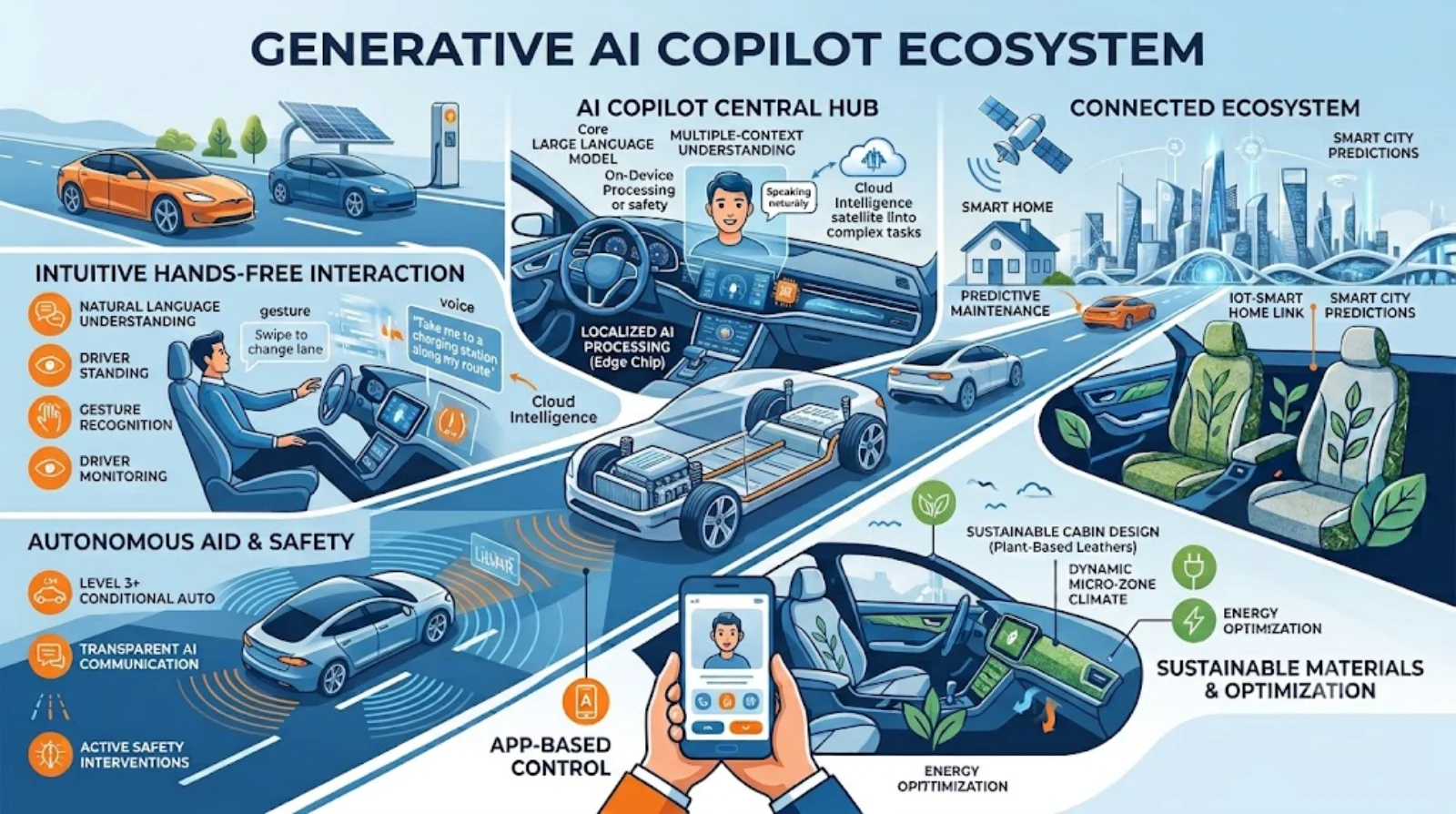
The automotive industry is undergoing a fundamental shift, evolving from simple mechanical transportation into intelligent, software-driven mobility hubs. At the heart of this transformation is the integration of Generative AI Copilots. Moving far beyond rigid, voice-command recognition systems of the past, generative AI copilots bring conversational intelligence, contextual awareness, and seamless hands-free control into the cabin.
As connected car ecosystems grow increasingly complex—encompassing solar charging, satellite communication networks, self-driving capabilities, and smart home automation—generative AI acts as the central brain orchestrating every interaction. Here is a comprehensive look into how Generative AI Copilots are revolutionizing the driving experience, making vehicle control more intuitive, safe, and personalized than ever before.
1. The Core Architecture of In-Vehicle Generative AI
Modern vehicles rely on high-performance compute platforms capable of processing generative AI models both locally on edge hardware and through high-speed cloud infrastructure. This dual-layer processing model ensures that critical vehicle controls remain functional even in zero-connectivity environments, while cloud connections handle heavy natural-language tasks and real-time data retrieval.
Conversational Natural Language Understanding (NLU)
Traditional voice assistants required drivers to memorize specific phrases to execute simple actions like setting temperature or tuning the radio. Generative AI copilots eliminate this barrier by utilizing advanced Large Language Models (LLMs) tuned specifically for automotive environments. Drivers can speak naturally, using casual language, indirect instructions, or complex multi-step commands.
- Contextual Comprehension: If a driver says, “I’m feeling a bit chilly and my windshield is starting to fog up,” the AI copilot understands the underlying intent without needing explicit commands. It automatically raises the cabin temperature and activates the front defroster.
- Multi-Turn Conversations: The system retains conversational memory. If you ask for nearby coffee shops, the copilot presents options. You can follow up with, “Which one has a drive-thru and is along our current route?” without needing to restate the original query.
On-Device Edge Processing vs. Cloud Intelligence
To deliver instant responses without latency, key safety and comfort functions run directly on the vehicle’s localized AI chip. The local system handles immediate vehicle telemetry, environmental controls, and basic navigation routines. Meanwhile, complex tasks—such as generating detailed travel itineraries, retrieving dynamic charging station updates, or interfacing with home automation—leverage 5G and satellite networks to access cloud-hosted generative AI models.
2. Intuitive Hands-Free Vehicle Management and Micro-Interactions
Safety remains the highest priority in vehicle design. Distracted driving caused by tapping touchscreens or scrolling through multi-tiered infotainment menus poses significant hazards. Generative AI copilots eliminate physical interaction requirements, establishing a complete hands-free operational framework.
Complete Climate, Media, and Navigation Control
The AI copilot connects natively to the vehicle’s Controller Area Network (CAN), giving it secure access to internal systems. Through voice or subtle gesture controls, drivers can execute complex adjustments effortlessly:
- Climate and Comfort Management: Regulate multi-zone temperatures, activate seat ventilation or heating, adjust ambient lighting schemes, and open or close sunroofs dynamically.
- Dynamic Route Optimization: Rather than typing addresses, drivers can describe their destination organically: “Take me to a quiet park nearby that has EV fast charging stations within walking distance.” The copilot cross-references live traffic, battery telemetry, and regional charger availability to create an optimal route.
- Media and Entertainment Synthesis: The copilot acts as a personal DJ and curator. It can summarize news headlines, curate personalized playlists based on your current mood or driving environment, and summarize incoming messages or emails concisely.
Advanced Gesture Recognition and App-Based Control
Complementing voice input, advanced interior camera sensors enable gesture-based commands. Drivers can raise or lower volume with a simple hand wave, answer or decline incoming calls with a gesture, or point at a window to open it. Furthermore, companion smartphone applications allow users to converse with their vehicle’s AI copilot remotely—setting departure temperatures, monitoring battery charging status, or sending navigation destinations before stepping into the car.
3. Synergy with Autonomous Driving and Driver Assistance Systems
As vehicles advance through Level 2+ and Level 3 conditional autonomy, the role of the driver shifts from active operator to supervisor. Generative AI copilots serve as the vital bridge between human drivers and automated vehicle systems, fostering trust and clarity.
Transparent AI Communication
One major challenge with autonomous systems is passenger uncertainty regarding vehicle decisions. AI copilots resolve this by providing real-time, natural-language explanations of automated actions:
- Route Explanations: “I am changing lanes to the left to avoid a slow-moving construction vehicle ahead.”
- Charging Decisions: “We are stopping at this solar-assisted charging station for 12 minutes because it provides the fastest charge rate and matches our target arrival battery percentage.”
Adaptive Driver Monitoring and Safety Interventions
Interior infrared sensors and micro-cameras continuously monitor driver fatigue, eye gaze, and attentiveness. When the copilot detects signs of drowsiness or distraction during manual driving modes, it can initiate proactive, conversational interventions:
- Adjusting cabin lighting and lowering temperature to increase alertness.
- Suggesting suitable rest stops or coffee locations along the route.
- Engaging the driver in light conversation to gauge responsiveness before suggesting an automated pull-over if fatigue is critical.
4. Expanding the Connected Vehicle Ecosystem
Generative AI copilots do not operate in isolation; they integrate the car into a broader digital ecosystem, connecting homes, smart grids, satellite networks, and personalized productivity apps.
Connected Home and Smart City Integration
Through Internet-of-Things (IoT) links, your vehicle communicates with your smart home setup while on the move. As you commute home, the AI copilot can predict your arrival time based on live traffic, adjust home heating or air conditioning, activate exterior security lights, and open garage doors seamlessly.
In smart city environments, the AI copilot communicates with connected infrastructure to:
- Predict traffic signal timing to recommend optimal driving speeds.
- Reserve parking spots equipped with compatible charging stations in advance.
- Coordinate energy transfer with solar-powered charging networks during peak efficiency hours.
Predictive Maintenance and Vehicle Health Diagnostics
By continuously analyzing internal sensor streams, the AI copilot transforms vehicle maintenance from reactive to proactive. Instead of triggering a generic warning light on the dashboard, the copilot provides clear, plain-language diagnostics:
- “Your tire pressure in the rear-left tire is dropping slowly due to a minor leak. I have scheduled an inspection at your preferred service center for tomorrow morning.”
- “Battery efficiency is performing optimally. Based on your upcoming weekend road trip, I recommend charging to 100% tomorrow evening during off-peak electricity hours.”
5. Sustainable Materials, Personalization, and the Future of Cabin Design
The inclusion of generative AI copilots directly influences physical interior design and overall cabin philosophy. As physical buttons, switches, and bulky center consoles are phased out in favor of streamlined, sustainable interior layouts, the AI copilot becomes the primary interface.
Eco-Friendly Interiors and Intelligent Climate Control
Modern cabins prioritize sustainable, recycled, and bio-based materials—such as synthetic plant-based leathers, recycled ocean plastics, and reclaimed wood trims. Generative AI copilots maximize the efficiency and lifespan of these sustainable cabins by managing localized climate micro-zones. Instead of conditioning the entire cabin volume, the copilot directs heating or cooling specifically toward occupied seats, lowering energy consumption and extending driving range.
Hyper-Personalized Driving Profiles
Generative AI copilots adapt to individual driver preferences over time. By recognizing driver voice profiles, facial geometry, or connected smartphones, the vehicle automatically adjusts:
- Seat positions, steering wheel placement, and mirror angles.
- Preferred driving modes (e.g., Eco, Comfort, or Sport) based on historical driving habits.
- Tailored audio soundscapes, ambient interior lighting tones, and custom news briefings.
Conclusion: The Road Ahead for In-Car AI Copilots
Generative AI copilots are redefining the relationship between humans and their vehicles. By converting complex technological networks—spanning satellite connectivity, EV charging grids, self-driving sensors, and smart home IoT—into effortless, natural conversations, these systems make driving safer, more efficient, and infinitely more enjoyable.
As software capability advances and edge computing hardware becomes more powerful, the AI copilot will continue to evolve from a helpful assistant into an indispensable co-driver, setting the standard for modern automotive mobility.