
One important point needs to be clarified about the McLaren Solus GT in 2026.
Unlike many mainstream cars that receive a new model-year version every year, the Solus GT is a very limited-production, track-only machine. McLaren originally planned just 25 examples, and the car was already an ultra-specialised product rather than a conventional mass-production model.
As of 2026, McLaren’s official Solus GT specifications continue to describe the same fundamental package: a naturally aspirated 5.2-litre V10 producing more than 840 PS or 829 bhp, a weight below 1,000 kg, 0–100 km/h acceleration in around 2.5 seconds and approximately 1,200 kg of downforce at 150 mph.
Therefore, there is no confirmed 2026 Solus GT facelift, new engine or officially announced major hardware upgrade that should be presented as a new model-year specification.
However, there are several aspects of the Solus GT that remain particularly relevant when discussing the car in 2026.
1. The 5.2-Litre V10 Remains the Main Attraction
The Solus GT continues to stand apart because of its naturally aspirated 5.2-litre V10.
The engine revs beyond 10,000 rpm and produces more than 829 bhp. Unlike many modern high-performance cars that combine a smaller turbocharged engine with hybrid assistance, the Solus GT remains focused on a large, naturally aspirated racing engine.
This is particularly significant in 2026 because the wider performance-car industry is increasingly adopting electrification and hybrid technology.
The Solus GT therefore remains an unusually mechanical interpretation of extreme performance.
2. The Single-Seat Layout Remains Unchanged
The Solus GT continues to use a single central seat.
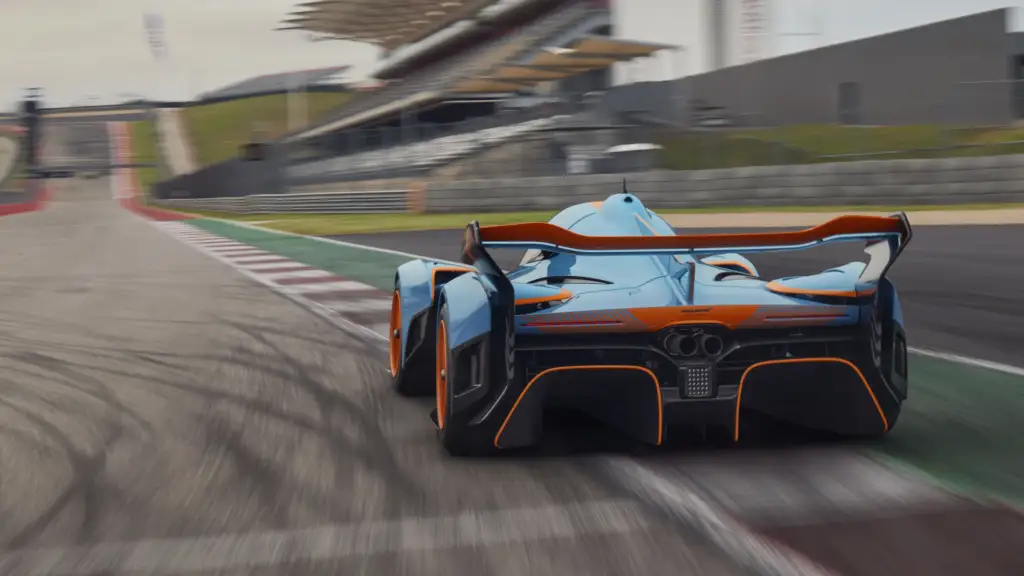
The driver sits in the centre of the carbon-fibre structure beneath a sliding glass canopy. McLaren describes the design as providing an experience close to a Formula 1 car.
This is not simply a styling feature.
The central driving position provides the driver with a very direct relationship with the car and allows McLaren to build the cockpit around a single occupant rather than having to package two or four seats.
In 2026, this remains one of the most unusual features of the Solus GT.
3. Extreme Aerodynamics Continue to Define the Car
There is also no confirmed 2026 replacement for the Solus GT’s existing aerodynamic package.
The car continues to use extensive aerodynamic bodywork, wheel shrouds, underbody aerodynamics and a large rear wing.
McLaren’s published specification gives the Solus GT approximately 1,200 kg of downforce at 150 mph.
This remains one of the most important characteristics of the car.
Rather than relying solely on tyre grip and mechanical performance, the Solus GT is designed to become increasingly planted as speed rises.
4. No 2026 Hybrid Powertrain Has Been Announced
One of the easiest mistakes to make when discussing McLaren’s 2026 technology is to assume that the Solus GT has received the same kind of electrification developments associated with other areas of McLaren’s racing programme.
That is not the case.
The Solus GT’s official specification remains centred around its naturally aspirated V10.
There is no confirmed 2026 update converting the Solus GT to a hybrid powertrain.
This is actually one of the reasons the car remains so distinctive.
While McLaren’s Formula 1 programme entered a major new technical era in 2026, including increased electrical power and significant aerodynamic changes, those Formula 1 regulations apply to the MCL40 race car, not the Solus GT.
5. The 2026 F1 Technology Should Not Be Confused With Solus GT Updates
McLaren’s Formula 1 car underwent major changes for the 2026 season.
The new F1 regulations introduced active aerodynamics, revised power-unit technology, a much stronger electrical component and changes to the chassis, tyres and overall vehicle dimensions. McLaren describes the 2026 regulations as one of the biggest technical changes in modern Formula 1.
The new F1 power unit continues to use a 1.6-litre V6 turbocharged combustion engine, but the MGU-H has been removed and the MGU-K has been significantly upgraded. The new system targets a roughly 50:50 contribution from combustion and electric power.
The 2026 F1 cars also introduced active front and rear aerodynamic systems, allowing the wings to change configuration between straight-line and cornering conditions.
These are genuine 2026 McLaren racing developments, but they are not announced Solus GT upgrades.
This distinction is important for accurate automotive reporting.
6. The Solus GT’s Virtual-to-Real Concept Remains Its Biggest Innovation
If there is one feature that continues to make the Solus GT feel futuristic in 2026, it is not a newly added component.
It is the car’s origin.
McLaren says the Solus GT started as a radical concept designed for virtual racing before becoming a real track car. Its production was limited to 25 customers.
That makes the Solus GT particularly relevant to today’s automotive design environment.
Modern manufacturers increasingly use digital modelling, simulation and virtual environments before physical development begins.
The Solus GT represents an extreme example of that process because the original vehicle was actually conceived as a virtual racing machine.
7. The Engine and Chassis Relationship Remains Race-Car Inspired
The Solus GT also continues to use a highly unusual structural arrangement.
The V10 engine is integrated into the vehicle’s structure, while the rear suspension is mounted around the seven-speed sequential gearbox. This approach is strongly influenced by racing-car engineering.
The car also uses double-wishbone suspension, with pushrod operation at the front and pull-rod architecture at the rear.
This isn’t the kind of suspension arrangement normally found on an everyday road car.
It is designed around controlling a lightweight vehicle operating under very high aerodynamic loads.
8. No Increase to 829 bhp Has Been Officially Announced
Another point worth highlighting for 2026 is the power figure.
McLaren’s current official information continues to state more than 840 PS or 829 bhp.
Some technical discussions of the Solus GT have mentioned higher output under ram-air conditions. For example, Top Gear reported 829 bhp normally and approximately 858 bhp with ram-air effects at higher speeds.
However, that should not be presented as a new 2026 engine upgrade.
The fundamental engine specification remains the same.
9. Weight Remains Below 1,000 Kg
The lightweight construction also remains central to the Solus GT formula.
McLaren officially lists the car at less than 1,000 kg, while detailed reporting has put the dry weight at approximately 935 kg.
This extremely low weight is one of the reasons the car can extract so much performance from its V10 engine.
Rather than adding more technology and weight to increase performance, the Solus GT follows a simpler racing principle:
reduce weight first, then add performance.
10. What Could Make the Solus GT Relevant Beyond 2026?
The Solus GT’s importance may ultimately have less to do with a traditional model-year update and more to do with what the car represents.
It demonstrates how digital automotive design can move from a gaming environment into real engineering.
It also shows that manufacturers can still create highly specialised machines around internal-combustion engines, lightweight construction and aerodynamic performance.
At the same time, McLaren’s wider 2026 activities show how quickly automotive and motorsport technology is evolving.
The company’s 2026 Formula 1 programme has moved into a new era of active aerodynamics, increased electrical power and revised vehicle architecture.
The Solus GT sits outside those regulations, which is precisely why it can remain such a mechanically focused machine.
McLaren Solus GT 2026 Update: What Actually Changes?
| Feature | 2026 Status |
|---|---|
| Engine | 5.2-litre naturally aspirated V10 |
| Power | 829 bhp / 840+ PS |
| Transmission | 7-speed sequential racing gearbox |
| Seating | Single-seat central cockpit |
| Weight | Under 1,000 kg |
| Dry weight reported | Around 935 kg |
| 0–100 km/h | Around 2.5 seconds |
| Top speed | Over 200 mph |
| Downforce | Around 1,200 kg at 150 mph |
| Production | 25 examples planned |
| Hybrid system | No confirmed 2026 Solus GT hybrid update |
| New 2026 engine | No confirmed update |
| 2026 facelift | No confirmed facelift |
| 2026 aerodynamic redesign | No confirmed redesign |
| Major 2026 F1 technology | Applies to MCL40, not Solus GT |
Final 2026 Verdict on the Solus GT’s Features
The most accurate way to describe the McLaren Solus GT in 2026 is not as a newly redesigned 2026 model, but as an extremely limited track machine whose original engineering remains extraordinary.
Its 5.2-litre naturally aspirated V10, central single-seat cockpit, sub-1,000-kg weight, extreme aerodynamic package and 25-car production run continue to define the car.
The major automotive technology changes introduced by McLaren in 2026 are primarily visible in its Formula 1 programme rather than in a new Solus GT specification.
That actually makes the Solus GT even more interesting.
While modern racing technology is moving rapidly toward electrification and active aerodynamic systems, the Solus GT remains a celebration of a different philosophy: a lightweight carbon-fibre machine, a screaming V10 and enormous aerodynamic grip.
It doesn’t need a conventional 2026 facelift to remain extraordinary.
Its original concept was already extreme enough.