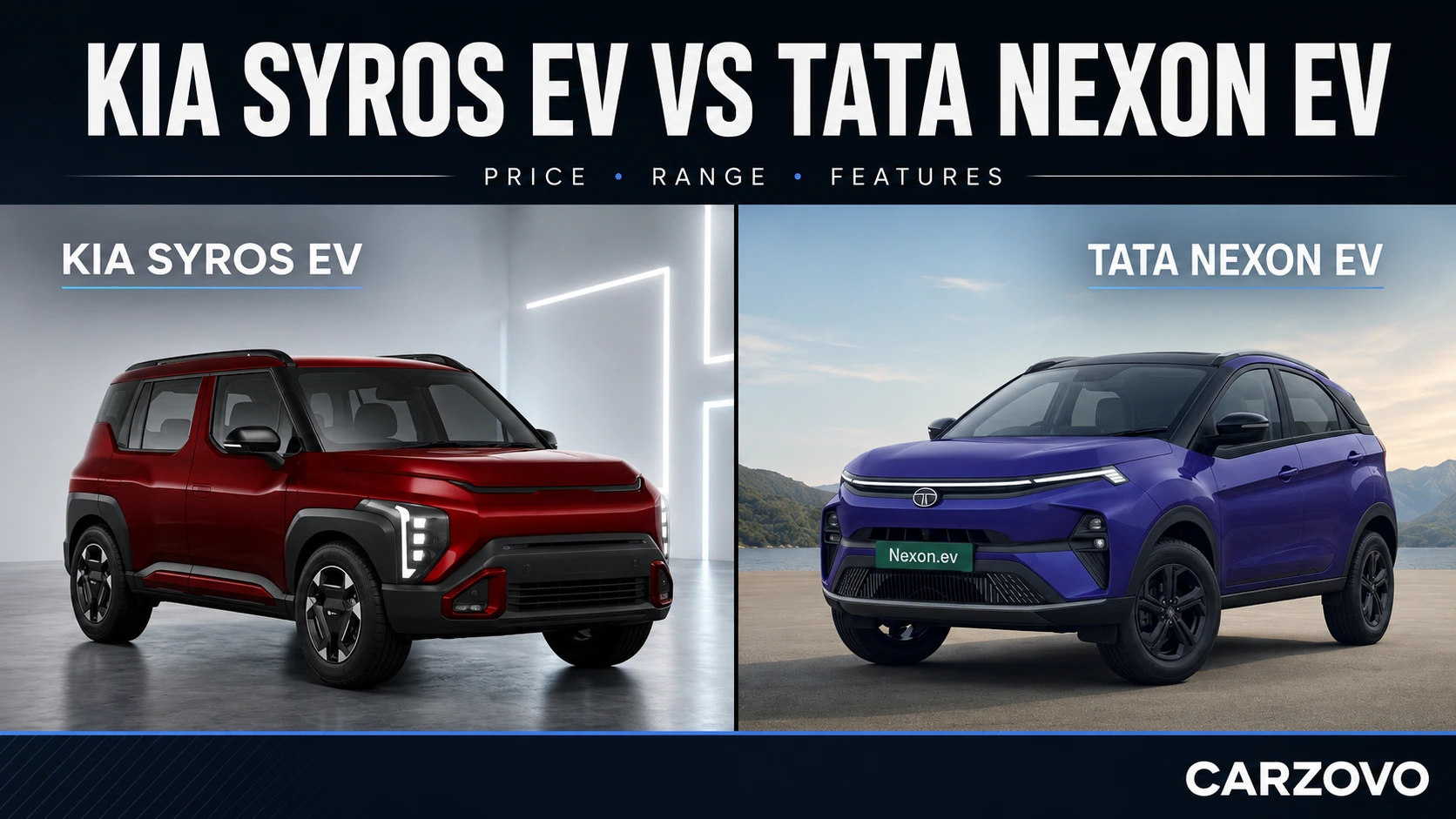
The newly launched Kia Syros EV has entered one of India’s most competitive electric SUV segments, where the Tata Nexon EV is already a familiar and established option.
Both electric SUVs are less than four metres long, offer multiple battery options and target buyers looking for a practical EV for city driving and occasional highway journeys. However, their priorities are noticeably different.
The Kia Syros EV focuses on maximum range, rear-seat comfort, premium technology and cabin space. The Tata Nexon EV counters with a lower starting price, proven market presence and a strong safety record.
Quick verdict: The Kia Syros EV is the better choice for buyers who want more range, space and premium features. The Tata Nexon EV makes more sense for buyers who want a more affordable and already established electric SUV.
Read our complete Kia Syros EV price, range, variants and launch details.
Kia Syros EV vs Tata Nexon EV: Specifications at a Glance
| Specification | Kia Syros EV | Tata Nexon EV |
|---|---|---|
| Starting price | ₹13.49 lakh | ₹12.49 lakh |
| Top price | ₹19.99 lakh | ₹17.49 lakh; Red Dark up to ₹17.69 lakh |
| Battery options | 42 kWh and 51.4 kWh | 30 kWh and 45 kWh |
| Maximum claimed range | 526 km | 489 km |
| Standard battery range | 443 km | 275 km |
| Maximum power | 171 PS | Approximately 150 PS |
| Maximum torque | 255 Nm | 215 Nm |
| Drivetrain | Front-wheel drive | Front-wheel drive |
| DC fast charging | 10–80% in approximately 39 minutes | 10–80% in approximately 40 minutes for 45 kWh |
| Length | 3,995 mm | 3,995 mm |
| Width | 1,805 mm | 1,802 mm |
| Height | 1,670 mm | 1,625 mm |
| Wheelbase | 2,550 mm | 2,498 mm |
| Boot space | 390 litres; up to 465 litres with seat adjustment | 350 litres |
| Infotainment screen | 12.3-inch touchscreen | 12.3-inch touchscreen |
| ADAS | Level 2 on the top variant | Level 2 on selected variants |
| Airbags | Six | Six |
The figures above are based on claimed or certified specifications. Actual driving range and charging time can vary according to speed, temperature, traffic, driving style, charger output and air-conditioning use.
Kia Syros EV vs Tata Nexon EV Price
The Kia Syros EV has been launched at a starting ex-showroom price of ₹13.49 lakh, with the fully equipped version priced at approximately ₹19.99 lakh.
The Tata Nexon EV starts lower at ₹12.49 lakh. Its regular variants extend to approximately ₹17.49 lakh, while the Red Dark Edition is priced at up to ₹17.69 lakh.
This makes the Nexon EV approximately ₹1 lakh more affordable at the entry level. The difference becomes larger at the top end, where the highest Syros EV variant costs more than ₹2 lakh extra.
Therefore, buyers with a strict purchase budget will find the Nexon EV easier to access. The Syros EV asks for a premium but offers a larger battery, longer range, more cabin space and several additional comfort features.
What About the Kia Syros EV BaaS Price?
Kia also offers a Battery-as-a-Service option under which the Syros EV chassis price starts at ₹7.99 lakh.
However, this should not be directly compared with the normal Nexon EV purchase price because the Syros EV battery is financed separately. Kia lists a battery payment starting at ₹3.3 per kilometre for the standard-range version and ₹3.8 per kilometre for the extended-range version, based on specified monthly usage and finance conditions.
Buyers should calculate the total battery payments over the planned ownership period before choosing BaaS over a conventional purchase.
Price winner: Tata Nexon EV
Battery and Range Comparison
Range is one of the biggest differences between these two electric SUVs.
The Kia Syros EV is available with:
- A 42 kWh battery offering a claimed range of 443 km
- A 51.4 kWh battery offering a claimed range of 526 km
The Tata Nexon EV is available with:
- A 30 kWh battery offering a claimed range of 275 km
- A 45 kWh battery offering a claimed range of 489 km
The standard-range Syros EV has a considerably larger battery than the entry-level Nexon EV. Its claimed range is also 168 km higher.
The difference between their larger battery versions is smaller, but the Syros EV still provides 37 km more claimed range than the Nexon EV 45.
For buyers who regularly travel between cities or do not have convenient access to a charger every day, the Syros EV’s additional battery capacity could provide greater confidence.
The Nexon EV 30 remains suitable for predictable city commuting, while its 45 kWh version is the better Nexon option for regular highway journeys.
Battery and range winner: Kia Syros EV
Expected Real-World Range
ARAI or MIDC-certified range should not be treated as the distance every owner will achieve during normal driving.
Actual range depends on traffic, road gradient, speed, tyre pressure, weather, passenger load, driving mode and air-conditioning use.
Based on their battery sizes and certified figures, the Syros EV 51.4 kWh should generally provide the longest usable range of the four available battery configurations. The Nexon EV 45 remains capable of intercity journeys, but it may require slightly more charging planning on longer routes.
A proper back-to-back real-world range test will provide a clearer comparison after the Syros EV becomes widely available.
Performance: Which EV Is More Powerful?
The 42 kWh Kia Syros EV produces approximately 135 PS, while the larger 51.4 kWh version produces up to 171 PS. Both versions deliver 255 Nm of torque.
The Nexon EV offers approximately 129 PS with its smaller battery configuration, while the larger battery version produces up to around 150 PS, depending on the version. Torque is rated at 215 Nm.
The Syros EV therefore has an advantage in both maximum power and torque. Its extended-range version should feel stronger during highway overtaking and when carrying passengers and luggage.
However, the Nexon EV is not underpowered for normal use. Its responsive electric motor and selectable drive modes should continue to make it suitable for urban traffic and highway driving.
Performance winner: Kia Syros EV
Charging Time Comparison
Kia says the Syros EV can charge from 10% to 80% in approximately 39 minutes when connected to a compatible 100 kW DC fast charger.
The Tata Nexon EV 45 can charge from 10% to 80% in approximately 40 minutes using a compatible 60 kW DC charger. Tata also lists a charging time of around 6 hours and 36 minutes from 10% to 100% using a 7.2 kW AC wall box for the larger battery version.
The headline DC charging times are almost identical. However, actual charging performance depends on battery temperature, the charger’s output, the starting charge level and whether another vehicle is sharing the charger’s available power.
Kia additionally supports an 11 kW AC charging option, which may be useful for owners with a compatible three-phase electricity connection and home charger.
Fast-charging result: Tie
Dimensions, Cabin Space and Boot Capacity
Both SUVs measure 3,995 mm in length. However, the Kia Syros EV is 45 mm taller, 3 mm wider and has a wheelbase that is 52 mm longer than the Nexon EV.
| Measurement | Kia Syros EV | Tata Nexon EV |
|---|---|---|
| Length | 3,995 mm | 3,995 mm |
| Width | 1,805 mm | 1,802 mm |
| Height | 1,670 mm | 1,625 mm |
| Wheelbase | 2,550 mm | 2,498 mm |
| Boot capacity | 390 litres; up to 465 litres | 350 litres |
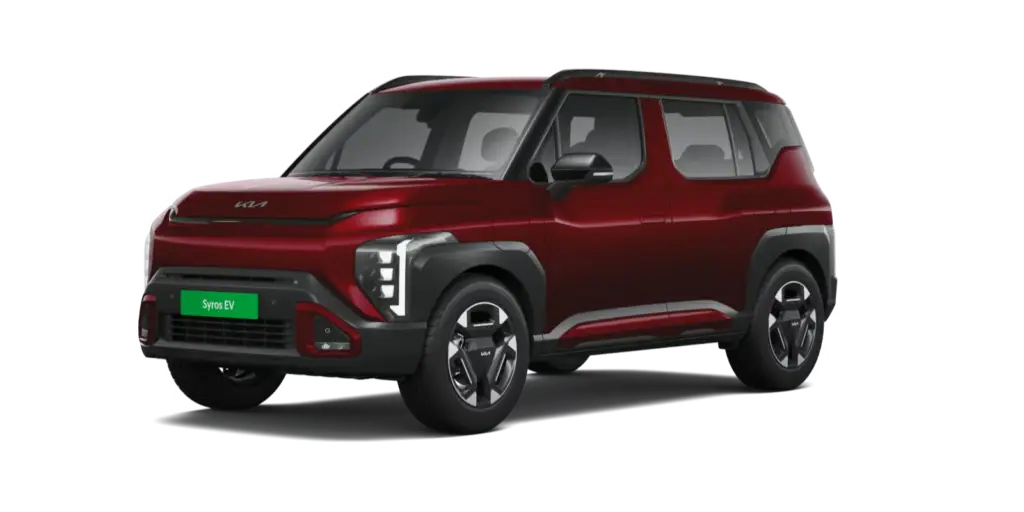
The longer wheelbase and taller body give the Syros EV an advantage in passenger space, particularly in the second row.
Its rear seat can slide and recline, allowing owners to prioritise either passenger legroom or luggage capacity. Kia lists 390 litres of boot space in certain configurations and up to 465 litres when the second-row seat is moved forward.
The Nexon EV provides a 350-litre boot. It remains adequate for daily use and shorter family trips, but the Syros EV is the more practical option for buyers who regularly travel with several passengers and large bags.
Space and practicality winner: Kia Syros EV
Interior and Technology Comparison
Both SUVs offer feature-rich cabins, large touchscreens, digital instrument displays, connected-car functions, wireless smartphone connectivity and panoramic sunroofs on selected variants.
Kia Syros EV Interior Highlights
The Syros EV offers a 30-inch Trinity Panoramic Display arrangement consisting of:
- A 12.3-inch digital instrument cluster
- A 12.3-inch infotainment touchscreen
- A 5-inch touchscreen for climate controls
Higher variants also offer all-row seat ventilation, including ventilation for the front seats and the thigh section of the rear seats. Other highlights include a four-way powered driver’s seat, Harman Kardon eight-speaker audio, 64-colour ambient lighting, wireless charging, a digital key, connected-car features and over-the-air updates.
Its sliding and reclining rear seat is another useful feature for families.
Tata Nexon EV Interior Highlights
The Nexon EV offers a 12.3-inch infotainment touchscreen, a 10.25-inch digital instrument cluster and a nine-speaker JBL sound system on higher variants.
It also offers front ventilated seats, a panoramic sunroof, wireless charging, connected technology, a digital key, automatic climate control and vehicle-to-load functionality.
A notable Nexon EV feature is Vehicle-to-Vehicle charging, which allows it to provide power to another compatible electric vehicle. The Syros EV offers internal Vehicle-to-Load functionality on its top X-Line variant but does not currently advertise V2V charging.
The Nexon EV has a strong equipment list, but the Syros EV moves ahead with its larger display arrangement, rear-seat ventilation, powered driver’s seat, longer feature list and more flexible second row.
Features and comfort winner: Kia Syros EV
Safety Comparison
Both electric SUVs offer important active and passive safety equipment, although feature availability depends on the selected variant.
The Kia Syros EV offers:
- Six airbags
- Electronic Stability Control
- Hill-start Assist Control
- All-wheel disc brakes
- Tyre-pressure monitoring
- Front, side and rear parking sensors on selected variants
- A 360-degree camera
- Blind View Monitor
- Level 2 ADAS with 16 autonomous functions on the X-Line ER
The Tata Nexon EV offers:
- Six airbags
- Electronic Stability Control
- All-wheel disc brakes
- Tyre-pressure monitoring
- A 360-degree camera
- Front and rear parking sensors
- Level 2 ADAS on selected variants
The Tata Nexon EV has received a five-star Bharat NCAP rating for adult and child occupant protection.
The petrol-powered Kia Syros has also received a five-star Bharat NCAP rating. However, that published result applies to the tested gasoline Syros variants, not specifically to the newly launched Syros EV. An EV-specific Syros result should not be assumed until Bharat NCAP publishes one.

Current crash-test confidence winner: Tata Nexon EV
Battery Warranty and Ownership
Kia offers a lifetime high-voltage battery warranty for the first owner of the Syros EV. Kia defines this as 15 years with unlimited kilometres, subject to its eligibility requirements and terms.
Tata also provides a lifetime high-voltage battery warranty for the first private owner of the Nexon EV 45 kWh. Tata defines lifetime as 15 years from the vehicle’s first registration, with unlimited kilometres under eligible private use.
The lifetime warranty does not apply in the same way to every registration type or every battery version. Buyers should confirm the exact warranty offered with their chosen variant and intended usage before booking.
Which One Is Better for City Driving?
The Tata Nexon EV 30 is the more sensible choice for buyers who:
- Mainly drive within the city
- Have predictable daily usage
- Can charge regularly at home
- Want the lowest purchase price
- Do not require maximum boot or rear-seat space
Its lower starting price makes it easier for first-time EV buyers to enter the segment.
The Syros EV 42 costs more, but its significantly higher claimed range makes it more flexible for buyers who combine city use with occasional highway travel.
City-focused value winner: Tata Nexon EV
Which One Is Better for Highway Travel?
The Kia Syros EV 51.4 is the stronger highway option because it provides:
- A higher 526 km claimed range
- More power and torque
- A larger battery
- More rear-seat space
- A larger adjustable boot
- Faster-compatible 100 kW DC charging
- Better comfort for passengers
The Nexon EV 45 can also handle intercity trips, but the Syros EV should require fewer charging stops over the same route under similar conditions.
Highway and long-distance winner: Kia Syros EV
Kia Syros EV vs Tata Nexon EV: Pros and Cons
Kia Syros EV Pros
- Longer claimed range
- Larger battery options
- More powerful electric motor
- Longer wheelbase and more cabin space
- Sliding and reclining rear seats
- Larger adjustable boot capacity
- Ventilated front and rear seats
- Premium three-screen dashboard layout
- Lifetime battery warranty for eligible first owners
Kia Syros EV Cons
- Higher starting price
- Top variant is considerably more expensive
- New model with limited long-term ownership data
- No Syros EV-specific Bharat NCAP result published yet
- BaaS pricing requires careful total-cost calculation
Tata Nexon EV Pros
- Lower entry price
- Established presence in the Indian EV market
- Five-star Bharat NCAP rating
- Multiple battery choices
- Strong feature list
- V2V and V2L functionality
- Lifetime battery warranty on the eligible 45 kWh version
- Lower top-variant price
Tata Nexon EV Cons
- Entry version has considerably less claimed range
- Smaller rear-seat area
- Smaller boot capacity
- Less power and torque
- Rear-seat ventilation is not available
Final Verdict: Kia Syros EV or Tata Nexon EV?
The Kia Syros EV is the overall comparison winner for buyers who can extend their budget.
It offers more claimed range, stronger performance, a larger cabin, better rear-seat comfort, more luggage flexibility and a longer list of premium features. The 51.4 kWh version is particularly attractive for families looking to use an EV as their primary vehicle for both city and highway journeys.
The Tata Nexon EV remains the better value choice. It is more affordable, has an established ownership base and carries a five-star Bharat NCAP rating. The 30 kWh version is suitable for budget-focused city users, while the 45 kWh version provides a stronger balance of range and affordability.
Choose the Kia Syros EV for range, space, performance and premium comfort.
Choose the Tata Nexon EV for affordability, proven ownership and an officially published EV crash-test rating.
Frequently Asked Questions
Is the Kia Syros EV better than the Tata Nexon EV?
The Kia Syros EV is better for buyers prioritising range, cabin space, boot capacity, performance and premium features. The Tata Nexon EV is better for buyers prioritising a lower purchase price and proven ownership experience.
Which has more range: Kia Syros EV or Tata Nexon EV?
The Kia Syros EV offers up to 526 km of claimed range with its 51.4 kWh battery. The Tata Nexon EV offers up to 489 km with its 45 kWh battery.
Which is cheaper: Syros EV or Nexon EV?
The Tata Nexon EV is cheaper, with prices starting at ₹12.49 lakh. The Kia Syros EV starts at ₹13.49 lakh. These are ex-showroom prices.
Which EV has the larger battery?
The Kia Syros EV has the larger maximum battery at 51.4 kWh. The Tata Nexon EV’s larger battery is rated at 45 kWh.
Which one has more boot space?
The Tata Nexon EV offers 350 litres of boot space. The Kia Syros EV offers 390 litres in its normal configuration and up to 465 litres when the sliding rear seat is moved forward.
Which is better for long-distance driving?
The Kia Syros EV 51.4 is better suited to regular long-distance driving because it offers more claimed range, higher power, greater cabin space and a larger adjustable boot.
Does the Kia Syros EV have a lifetime battery warranty?
Kia offers a lifetime high-voltage battery warranty for eligible first owners. Kia defines lifetime as 15 years with unlimited kilometres, subject to its terms and conditions.
Which one has a better safety rating?
The Tata Nexon EV has an official five-star Bharat NCAP rating. The petrol Kia Syros has also received five stars, but an EV-specific Bharat NCAP result for the Syros EV had not been separately published at the time of writing.