Imagine driving on a busy road when your car receives a warning that another vehicle has suddenly applied its brakes several metres ahead. At the same time, it alerts you about an approaching ambulance, a dangerous intersection or a vehicle travelling in the wrong direction.
These capabilities represent the future of automotive connectivity, and one technology making them possible is Vehicle-to-Everything (V2X) communication.
Modern cars already use cameras, radar, ultrasonic sensors and GPS to understand their surroundings. However, these systems have limitations. A vehicle cannot always detect something hidden behind a large truck, around a blind corner or beyond the range of its sensors.
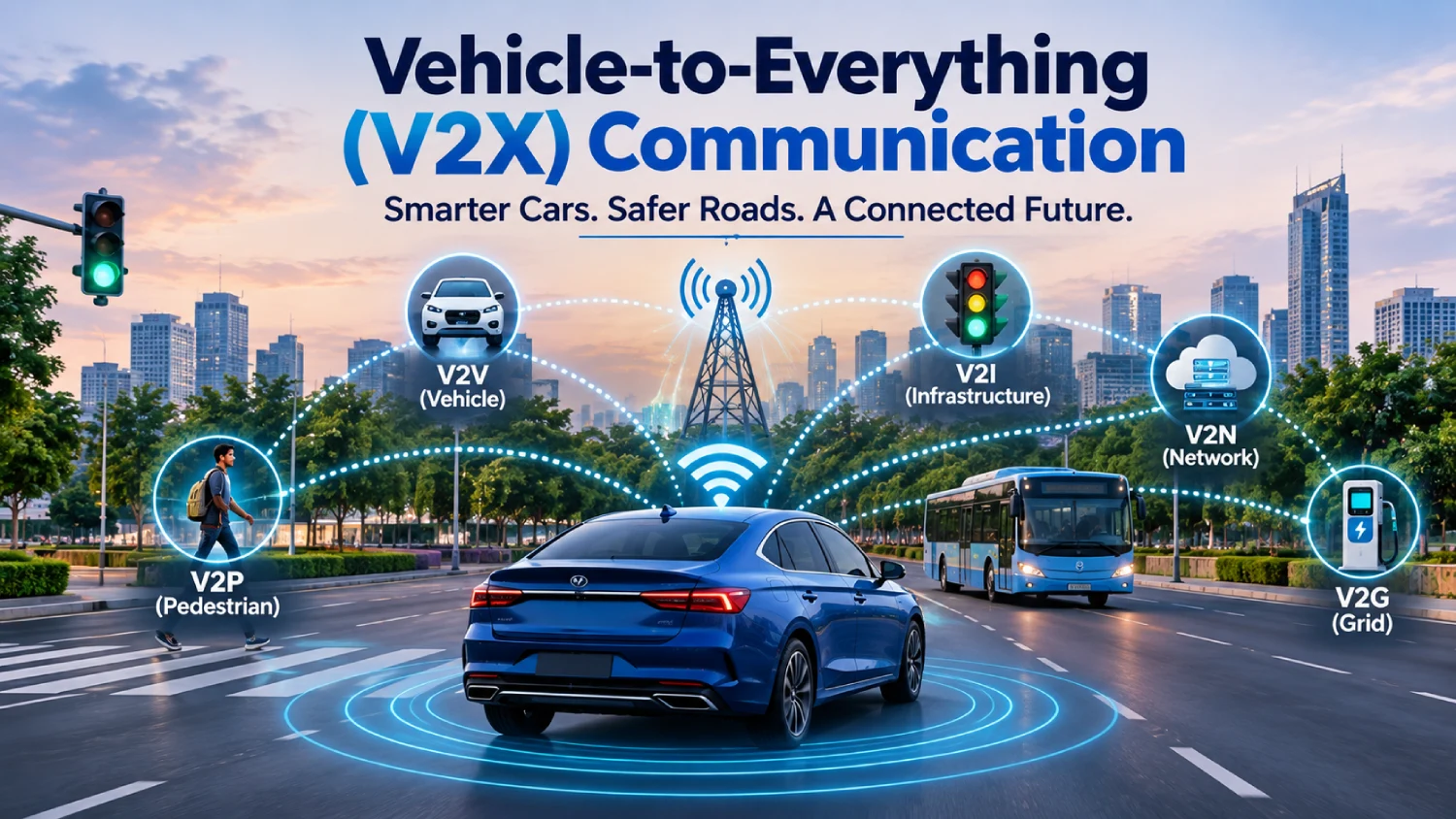
V2X technology aims to overcome this limitation by allowing vehicles to exchange information with other vehicles, traffic signals, road infrastructure, pedestrians and network systems.
In 2026, V2X is becoming an important subject in the automotive industry because of developments in connected vehicles, 5G communication, intelligent transportation systems and autonomous driving.
India has also taken an important step towards this technology by introducing a draft regulatory framework for vehicle-to-vehicle communication. This development could influence how future vehicles are manufactured and how road safety systems operate across the country.
What Is Vehicle-to-Everything (V2X) Communication?
Vehicle-to-Everything, commonly known as V2X, is a communication technology that allows vehicles to exchange information with their surroundings through wireless networks.
Instead of depending entirely on onboard sensors, a connected vehicle can receive information from nearby vehicles, traffic infrastructure and other connected devices.
For example, imagine approaching an intersection where a truck blocks your view of an incoming motorcycle. Your car’s camera may not detect the motorcycle in time. However, if both vehicles are equipped with compatible V2X systems, they can exchange information about their position and movement.
The system can then provide an early warning to the driver.
V2X is not a replacement for existing vehicle safety systems. It is designed to complement technologies such as Advanced Driver Assistance Systems (ADAS), automatic emergency braking, adaptive cruise control and collision warning systems.
Its main objective is to improve a vehicle’s awareness beyond what its own sensors can directly observe.
How Does V2X Communication Work?
V2X communication uses wireless technology to exchange information between connected vehicles and surrounding infrastructure.
A vehicle equipped with a V2X communication unit can transmit information such as:
- Vehicle location and direction.
- Current speed and acceleration.
- Sudden braking information.
- Road and traffic conditions.
- Potential collision warnings.
- Emergency vehicle movement.
- Information received from connected traffic signals.
Other compatible vehicles or infrastructure systems can receive this information and process it to identify potential dangers.
The vehicle may then display a warning on the instrument cluster, head-up display or infotainment screen. Depending on the vehicle’s technology and safety permissions, certain warnings may also support automated driver-assistance functions.
V2X systems generally use dedicated short-range wireless communication or cellular-based communication technologies.
One important development is Cellular Vehicle-to-Everything (C-V2X), which uses cellular communication technology to support vehicle connectivity.
C-V2X can operate through two important communication approaches:
Direct communication: Vehicles and road infrastructure exchange information directly over a dedicated radio interface without requiring data to travel through a mobile network.
Network-based communication: Vehicles communicate through cellular network infrastructure, which can help provide information over wider geographical areas.
The combination of direct and network-based communication can support a wider range of road-safety and traffic-management applications.
Different Types of V2X Communication
V2X is a broad technology category. It includes several communication systems, each designed for a particular purpose.
1. Vehicle-to-Vehicle (V2V)
Vehicle-to-Vehicle communication allows two or more vehicles to exchange information directly.
For example, if a car suddenly brakes on a highway, it can transmit an emergency braking alert to nearby connected vehicles.
A following vehicle may receive this warning before its driver can visually identify the danger.
V2V can support:
- Forward collision warnings.
- Emergency braking alerts.
- Unsafe lane-change warnings.
- Wrong-way driving alerts.
- Information about approaching vehicles.
This is particularly useful on highways, where vehicles travel at higher speeds and drivers may have limited time to react.
2. Vehicle-to-Infrastructure (V2I)
Vehicle-to-Infrastructure communication connects vehicles with roadside systems such as traffic signals, road sensors, electronic signboards and intelligent traffic-management equipment.
For example, a connected traffic signal can communicate its current status to an approaching vehicle.
The driver may receive information about how long the signal is expected to remain red or green, where such infrastructure support is available.
V2I can help with:
- Traffic signal information.
- Roadwork warnings.
- Speed-limit notifications.
- Accident-zone alerts.
- Traffic congestion management.
- Smart parking information.
This technology could become particularly useful in Indian cities where traffic congestion and complicated intersections are common.
3. Vehicle-to-Pedestrian (V2P)
Vehicle-to-Pedestrian communication focuses on improving safety for pedestrians and other vulnerable road users.
Connected smartphones, wearable devices or other compatible equipment can communicate information about a pedestrian’s presence and movement.
For example, a vehicle approaching a pedestrian crossing could receive a warning about a person entering the road from an area with limited visibility.
V2P can be useful around schools, hospitals, residential areas and crowded urban intersections.
However, it depends on compatible devices, reliable positioning and appropriate privacy and security safeguards.
4. Vehicle-to-Network (V2N)
Vehicle-to-Network communication connects vehicles to cellular networks and cloud-based services.
It can provide information that is not limited to the immediate surroundings of a vehicle.
Examples include:
- Live traffic information.
- Accident notifications.
- Weather-related road alerts.
- Cloud-based route recommendations.
- Connected vehicle services.
- Remote vehicle diagnostics.
Unlike direct V2V communication, V2N generally relies on mobile network connectivity.
5. Vehicle-to-Grid (V2G)
Vehicle-to-Grid communication connects electric vehicles with electricity networks and smart charging infrastructure.
It can allow compatible electric vehicles to communicate with charging systems and, in certain configurations, send stored electricity back to the grid.
V2G is especially relevant as electric vehicle adoption increases.
It can support smart charging, energy management and better use of renewable electricity.
However, V2G requires compatible vehicles, charging equipment, grid infrastructure and suitable electricity regulations.
V2X Communication in India: Major Developments in 2026
India has made important progress towards introducing vehicle-to-vehicle communication as part of its broader intelligent transportation system development.
One of the most significant developments came in August 2026, when the Ministry of Road Transport and Highways published a draft notification proposing phased implementation of V2V communication systems in motor vehicles.
The proposal covers vehicle categories L, M and N, which broadly include two-wheelers and three-wheelers, passenger vehicles and goods vehicles.
The draft framework identifies AIS-230 as the technical standard for factory-installed V2V communication systems using Cellular Vehicle-to-Everything technology.
Proposed implementation timeline
The draft notification proposes the following schedule:
- From 1 October 2027, vehicles fitted with V2V communication systems would need to comply with AIS-230.
- From 1 October 2028, new vehicles in the specified categories would be required to be fitted with V2V communication systems conforming to AIS-230.
These are proposed implementation dates under the draft framework, not confirmation that the final mandatory requirements are already in force.
The standard addresses technical performance, positioning, radio communication, electromagnetic compatibility and cybersecurity requirements.
It also identifies important safety applications, including emergency brake alerts, forward collision warnings, wrong-way driving warnings and emergency vehicle alerts.
India’s 5.9 GHz communication development
Another important development took place in June 2026, when the Department of Telecommunications introduced rules providing licensing exemptions for specified onboard C-V2X equipment operating in the 5.9 GHz band.
This is an important step because connected vehicle communication requires suitable radio-frequency arrangements and technical conditions.
Together, the spectrum-related development and the AIS-230 framework provide a foundation for introducing compatible V2X systems in India.
The direction is clear: vehicle connectivity is gradually becoming part of India’s future road-safety and automotive technology planning.
How V2X Can Improve Road Safety
Road accidents can occur because drivers cannot always identify hazards early enough.
Traditional safety systems mainly depend on information collected through cameras, radar, ultrasonic sensors and other onboard equipment.
V2X can add another layer of awareness by allowing vehicles to receive information from sources outside their immediate sensor range.
Early collision warnings
A vehicle approaching a traffic queue may receive an emergency braking alert from a car further ahead.
This can give the driver additional time to slow down and avoid a collision.
Blind intersection protection
At intersections where buildings, buses or parked vehicles block visibility, V2X can help compatible vehicles exchange information about their movement.
This may help reduce the risk of side-impact collisions.
Emergency vehicle alerts
Ambulances, fire engines and other emergency vehicles could communicate their location and movement to nearby connected vehicles.
Drivers may receive an early warning and get more time to make way.
Wrong-way driving detection
If a vehicle travels in the wrong direction on a road, its communication system could transmit information that helps warn approaching connected vehicles.
This application could be especially useful on highways and expressways.
Protection for pedestrians
V2X-based pedestrian warnings could help vehicles identify potential conflicts around crossings, schools and crowded public spaces.
The technology is particularly relevant where a pedestrian may enter the road from behind a parked vehicle or another visual obstruction.
V2X vs ADAS: What Is the Difference?
V2X and ADAS are related technologies, but they perform different functions.
ADAS uses sensors such as cameras and radar to observe the vehicle’s surroundings and assist the driver.
V2X allows vehicles to exchange information with other connected vehicles and infrastructure.
For example, adaptive cruise control uses onboard sensors to maintain distance from a vehicle ahead. V2X could provide an additional warning about sudden braking involving a vehicle further ahead, even when it is not directly visible.
The two technologies can therefore work together.
A future vehicle may combine cameras, radar, GPS, onboard computing and V2X communication to develop a more complete understanding of its surroundings.
V2X Communication and Autonomous Driving
Autonomous driving depends on a vehicle’s ability to understand its surroundings, identify hazards and make decisions.
Cameras, radar and LiDAR provide important information, but they cannot always identify objects hidden behind obstacles or outside their detection range.
V2X can help provide additional information from other connected road users and infrastructure.
For example, an autonomous vehicle approaching a complicated intersection could receive information about other vehicles entering the same intersection.
This additional information may help its decision-making system plan a safer movement.
V2X can also support coordinated traffic movement, automated highway driving and future intelligent transportation systems.
However, V2X alone cannot make a vehicle fully autonomous. Safe autonomous driving requires reliable sensors, advanced computing, software validation, cybersecurity and appropriate regulatory approval.
V2X and 5G: Why Connectivity Matters
The development of 5G networks has increased interest in connected vehicle technology.
5G offers capabilities such as improved network capacity, support for large numbers of connected devices and the potential for low-latency communication in suitable network conditions.
These capabilities can support applications where vehicles need to exchange information quickly.
However, not every V2X safety application depends on a public 5G network.
Direct C-V2X communication can allow nearby vehicles to exchange safety messages without relying on cellular network coverage.
Network-based communication can complement direct communication by providing wider-area information and cloud-connected services.
The combination of both approaches is important for developing a flexible connected transportation system.
Challenges Facing V2X Technology in India
Despite its potential, V2X implementation will require considerable investment, planning and coordination.
1. Infrastructure development
For V2X to deliver its full potential, roads, traffic signals and other infrastructure may need compatible communication equipment.
Installing roadside units and maintaining them across a large road network will require investment.
2. Vehicle compatibility
V2X works best when vehicles use compatible communication standards.
If different manufacturers use systems that cannot exchange information properly, the technology’s effectiveness may be reduced.
This is why common technical standards such as AIS-230 are important.
3. Cybersecurity and data privacy
Connected vehicles exchange information about their position, speed and movement.
This creates cybersecurity risks if communication systems are not properly protected.
Manufacturers and infrastructure providers will need strong authentication, secure message handling, software updates and privacy safeguards.
4. Network reliability
Road-safety warnings must be delivered reliably and quickly.
Communication delays, interference, weak network coverage and inaccurate positioning could affect the usefulness of certain applications.
Direct communication can help address some network-coverage limitations, but reliable implementation still requires careful engineering and testing.
5. Implementation cost
V2X communication units, antennas, software and supporting infrastructure may increase vehicle and system costs.
Manufacturers will need to balance safety improvements with affordability, especially in price-sensitive vehicle segments.
What Does the Future of V2X Look Like?
The next stage of V2X development will focus on making communication more intelligent, reliable and useful in real driving conditions.
Several areas are expected to receive attention.
AI-powered traffic management: Artificial intelligence could analyse information from connected vehicles and infrastructure to improve traffic flow and identify potential hazards.
Smart intersections: Traffic signals may exchange information with vehicles to improve intersection safety and reduce unnecessary waiting.
Connected emergency response: Ambulances and emergency vehicles could share their location and movement to help surrounding traffic make way.
Electric vehicle integration: V2X could work alongside smart charging and vehicle-to-grid technologies to improve energy management.
Autonomous mobility: Connected vehicles could exchange information to support coordinated driving and improve awareness in complex road environments.
International technical development is also continuing. In 2026, industry organisations have been studying more advanced C-V2X applications involving intersection safety, vulnerable road users and high-speed rear-end collision scenarios.
These developments indicate that V2X is moving beyond basic vehicle awareness towards more advanced connected mobility applications.
Is V2X the Future of Indian Cars?
V2X has the potential to become one of the most important developments in automotive safety.
India’s proposed AIS-230 implementation framework is a significant step towards bringing compatible vehicle communication systems into the market.
However, widespread adoption will not happen overnight. Manufacturers, telecom providers, infrastructure authorities and regulators will need to work together.
The technology will also need to prove its reliability under Indian road conditions, where vehicles, pedestrians, road layouts and traffic behaviour can vary significantly.
For car buyers, V2X may not yet be a deciding factor when purchasing a vehicle, but it is a technology worth watching.
As connected cars become more common, communication between vehicles and their surroundings could become as important as airbags, ABS and ADAS.
V2X is not simply about making cars more connected. It is about helping vehicles understand what is happening around them before a driver can see the danger. That ability could play a major role in creating safer roads and smarter transportation systems in India.