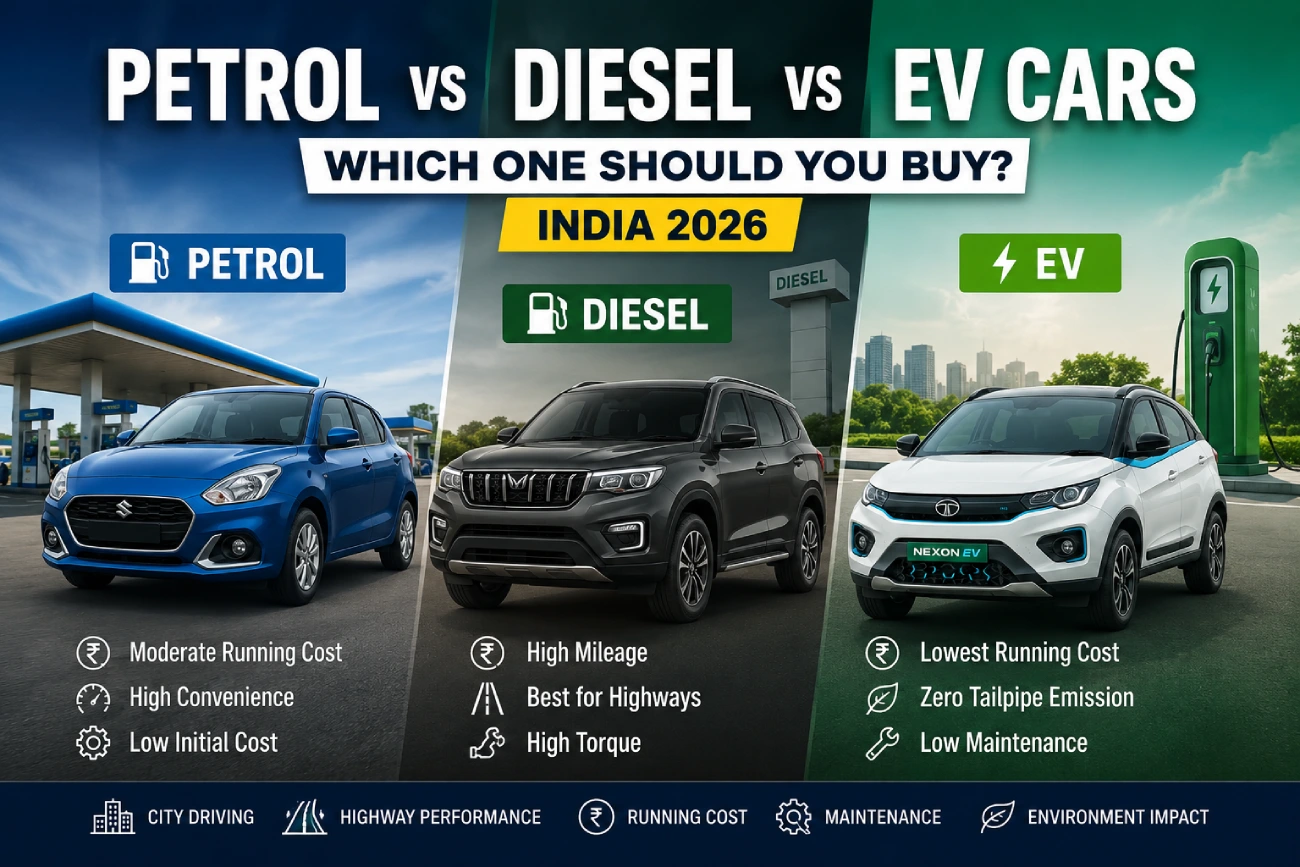
Car Fuel Choice
Buying a car in India in 2026 is no longer simply a choice between petrol and diesel. Electric vehicles have become a genuine third option, offering extremely low running costs and a quieter driving experience. At the same time, petrol cars continue to be popular because of their flexibility, while diesel cars remain attractive for buyers who regularly drive long distances.
The right choice depends on several factors, including your annual driving distance, city or highway usage, budget, maintenance expectations and access to charging infrastructure. A car that is perfect for a daily city commuter may not be the best option for someone who frequently travels between cities.
So, when comparing petrol vs diesel vs EV cars in India in 2026, there is no single winner for everyone. Each powertrain has its own advantages and limitations.
Petrol vs Diesel vs EV: Basic Comparison
| Factor | Petrol | Diesel | EV |
|---|---|---|---|
| Initial cost | Lower | Higher | Usually higher |
| Running cost | Medium | Medium-low | Lowest |
| Maintenance | Moderate | Higher | Lower |
| City driving | Excellent | Good | Excellent |
| Highway driving | Excellent | Excellent | Good |
| Refuelling/charging | Very quick | Very quick | Longer |
| Long-distance travel | Excellent | Excellent | Requires planning |
| Driving refinement | Very good | Good | Excellent |
| Engine maintenance | Required | Higher | Minimal |
| Best suited for | General users | High-mileage users | City/high-mileage users |
| Environmental impact | Higher | Higher | Lowest during driving |
Petrol Cars in India 2026
Petrol remains the most convenient choice for a large number of Indian car buyers. One of its biggest advantages is the availability of petrol stations across cities, towns and highways. You don’t need to plan your journey around fuel availability, making petrol cars particularly convenient for people who frequently travel to different locations.
Modern petrol engines are also refined and relatively quiet. Turbo-petrol engines have further improved performance, allowing smaller engines to provide strong acceleration while maintaining reasonable fuel efficiency.
Another major advantage is the lower purchase price compared with many equivalent diesel or electric models. For buyers who don’t drive very high annual kilometres, this lower upfront cost can make petrol financially attractive.
However, petrol cars generally have a higher running cost than diesel and electric cars. If you drive 1,500–2,000 km every month, the additional fuel expense can become significant over several years.
Petrol therefore remains an excellent option for buyers who want flexibility, easy refuelling, moderate annual usage and a lower initial purchase price.
Diesel Cars in India 2026
Diesel cars have lost some of their popularity compared with previous years, but diesel technology is still relevant in the Indian market. The biggest strength of diesel remains its combination of fuel efficiency and strong torque.
This becomes particularly useful in SUVs and larger vehicles. A diesel SUV can feel effortless when climbing hills, carrying several passengers or overtaking on highways.
Diesel engines are also generally efficient during long-distance driving. For someone covering 20,000 km or more annually, particularly with a significant amount of highway driving, the fuel savings can become meaningful.
The disadvantage is that modern diesel engines are more technically complex because of stricter emission requirements. Components associated with emissions control can increase maintenance costs if problems occur.
Diesel engines are also not necessarily the best choice for people who mainly drive short distances in heavy city traffic. A diesel vehicle that is rarely taken on longer drives may not provide the ownership advantages that make diesel attractive in the first place.
For 2026, diesel makes the most sense for high-mileage owners, highway users and buyers who want strong torque and efficient long-distance performance.
Electric Cars in India 2026
Electric cars have become one of the most interesting choices for Indian buyers. Their biggest advantage is extremely low energy cost compared with conventional petrol and diesel vehicles.
An EV doesn’t have a conventional internal-combustion engine, exhaust system or traditional engine oil system. This significantly reduces the number of mechanical components that require regular servicing.
Electric motors also provide instant torque. This makes EVs particularly enjoyable in city traffic, where quick acceleration and smooth power delivery can make everyday driving easier.
Charging is the biggest difference between owning an EV and a conventional car. A petrol or diesel car can be refuelled within minutes, while an EV normally requires more time. Home charging can make this less of a problem because the car can be charged overnight while it is parked.
However, buyers living in apartments should check whether dedicated parking and charging facilities are available before purchasing an EV.
EVs are particularly attractive for people who drive regularly in cities and have reliable access to home or workplace charging.
Running Cost: EV Has the Biggest Advantage
Running cost is one of the strongest reasons buyers are considering electric cars in 2026.
A petrol car can typically require considerably more money per kilometre than a home-charged EV. Diesel can reduce the gap because of its better fuel economy, but electricity remains substantially cheaper as an energy source when charging costs are controlled.
| Powertrain | Indicative Running Cost | Best Usage |
|---|---|---|
| Petrol | ₹6–₹8/km | Mixed usage |
| Diesel | ₹5–₹6/km | Highway/high mileage |
| EV | ₹1–₹2.50/km | City/home charging |
These figures are indicative because actual costs depend on the vehicle’s efficiency, fuel prices, electricity tariff, traffic conditions and driving style.
For example, someone driving 15,000 km every year could potentially save a substantial amount on energy costs with an EV compared with a petrol vehicle. Over five years, the difference can become significant.
However, the purchase price of an EV can be higher, so buyers should consider the total cost of ownership rather than comparing running costs alone.
Maintenance Cost: EV Takes the Lead
Maintenance is another major difference between these three technologies.
Petrol cars require regular engine oil, filters, spark plugs and other engine-related servicing. Diesel cars can have additional components and systems that may increase maintenance expenses.
An EV has considerably fewer mechanical components. There is no conventional engine oil, spark plug or exhaust system, and regenerative braking can reduce brake-pad usage.
That doesn’t mean EV ownership is completely maintenance-free. Tyres, suspension components, brakes, air-conditioning systems and other conventional vehicle parts still require attention. Battery health is also an important consideration.
Before purchasing an EV, buyers should carefully examine the battery warranty and understand what is covered by the manufacturer.
Which Is Best for City Driving?
For predominantly city driving, an EV is arguably the strongest choice in 2026, provided charging is convenient.
Frequent stop-and-go traffic is where electric cars perform particularly well. Instant torque, quiet operation and low energy costs make them well suited to urban conditions.
Petrol is the second most practical choice because refuelling is easy and there are no charging concerns.
Diesel can still work well in cities, but if your driving consists mainly of short daily trips, its advantages over petrol become less significant.
Which Is Best for Highway Driving?
Highway driving changes the equation.
Diesel remains an excellent choice for frequent long-distance travel because of its fuel efficiency and strong torque. Petrol also performs very well because fuel stations are widely available.
Electric cars can now handle many highway journeys, but planning is more important. Drivers need to consider charging locations, charging time and the vehicle’s real-world range.
For occasional road trips, this may not be a major problem. For people who regularly drive hundreds of kilometres without predictable stops, petrol or diesel can still offer greater convenience.
Which One Is More Economical in the Long Run?
The answer depends on how much you drive.
If you drive only 5,000–7,000 km annually, purchasing a significantly more expensive EV may not provide enough fuel savings to justify the higher initial investment.
For someone driving 15,000–20,000 km annually, however, lower EV running and maintenance costs can become much more meaningful.
Diesel follows a similar principle. A diesel vehicle generally makes more sense when its higher purchase and maintenance costs can be recovered through frequent driving and better highway fuel efficiency.
This means annual mileage should be one of the most important factors in your buying decision.
Petrol vs Diesel vs EV: Which One Should You Buy in 2026?
If you want the simplest all-round ownership experience, petrol remains a strong choice. It offers easy refuelling, broad availability and a lower entry price.
If you regularly travel long distances and spend significant time on highways, diesel can still be the better option, particularly for larger SUVs and high-mileage users.
If you primarily drive in the city, cover substantial kilometres and have access to dependable home charging, an EV can offer the lowest running cost and excellent everyday comfort.
The biggest mistake would be choosing a powertrain simply because it is currently considered the most popular or economical. Your driving pattern matters more.
Running Cost Comparison in 2026
The running-cost gap is where the three technologies become particularly interesting.
Indicative running cost in India, 2026
Approximate energy cost per kilometre under typical conditions; actual costs vary by vehicle, fuel/electricity prices and driving conditions.₹0₹2₹4₹6₹8PetrolDieselEV (home)
A petrol car could cost around ₹6–₹8 per km, diesel around ₹5–₹6 per km and a home-charged EV around ₹1–₹2.50 per km. These should be treated as indicative 2026 figures rather than fixed national prices.
This is why an EV can become particularly attractive for high-mileage city users.
Maintenance: EV Has the Biggest Advantage
Maintenance is another area where EVs have a clear advantage.
A petrol vehicle requires periodic engine oil, filters, spark plugs and other engine-related servicing. Diesel vehicles can require even more expensive maintenance because of their turbocharging and emission-control systems.
EVs eliminate most of these conventional engine-service requirements. Their maintenance schedule is generally focused on tyres, brakes, suspension, cooling systems, software checks and other standard vehicle components.
Regenerative braking can also reduce brake-pad wear because the electric motor helps slow the vehicle.
However, EV buyers should not assume that every repair will be cheap. The battery is the most important high-value component, and buyers should carefully check the battery warranty, charging warranty terms and manufacturer support before purchasing.
Which Car Is Better for City Driving?
For predominantly urban driving, the ranking is fairly straightforward.
EV comes first if home charging is available.
The instant torque, quiet operation and low running cost make electric cars extremely comfortable in traffic. Daily charging can also eliminate frequent visits to petrol pumps.
Petrol comes second because it offers convenience without requiring charging infrastructure.
Diesel comes third for purely urban usage. A diesel can still be comfortable and efficient, but its higher complexity and suitability for longer runs make it less compelling for short daily commutes.
Which Is Better for Highway Travel?
Highway driving changes the equation.
Diesel remains one of the strongest choices for frequent highway users because of its efficiency, torque and quick refuelling. Petrol is also excellent because petrol stations are widespread and refuelling takes only a few minutes.
EVs have improved significantly, but highway travel still requires more planning. You need to know where reliable fast chargers are located and consider charging time during longer journeys.
That does not mean EVs are unsuitable for road trips. It simply means your route and charging infrastructure matter more than they do with petrol or diesel.
Five-Year Ownership: Don’t Look Only at the Purchase Price
One of the biggest mistakes buyers make is comparing only the ex-showroom price.
Suppose an EV costs ₹2–₹4 lakh more than a comparable petrol model. At first, the petrol car appears cheaper. But if you drive 15,000–20,000 km every year, the EV’s lower energy and maintenance costs can gradually recover part of that initial premium.
The opposite is also true. If you drive only 5,000–7,000 km annually, fuel savings may not be sufficient to recover a large EV purchase premium quickly.
The same principle applies to diesel. A diesel car generally makes more financial sense when the owner drives enough kilometres to recover its higher purchase and maintenance costs.
Your annual mileage is therefore more important than simply asking which fuel is cheapest.
Petrol vs Diesel vs EV: Which One Should You Buy?
For most buyers in 2026, there is no universal winner.
Choose petrol if you want the easiest all-round ownership experience, drive moderate kilometres and regularly travel to places where charging infrastructure may be limited.
Choose diesel if you regularly cover high annual kilometres, spend considerable time on highways and want strong torque and highway efficiency.
Choose an EV if most of your driving is in the city, you cover significant kilometres and, most importantly, have dependable home charging.
The EV case has become stronger in 2026 as fuel prices have risen and consumers increasingly focus on running costs. June 2026 passenger-vehicle retail data showed alternative-fuel vehicles reaching a record 40.35% share, although that category includes more than just EVs.
The Verdict for Indian Buyers in 2026
If your priority is lowest running cost, EV wins.
If your priority is highway efficiency and long-distance driving, diesel remains highly competitive.
If your priority is simplicity and flexibility, petrol is still the safest all-round choice.
The most important question isn’t “Which fuel is best?” It is “Which powertrain fits my driving pattern?”
For a city commuter with home charging, an EV can be the smartest long-term choice. For a highway-heavy owner covering 20,000–30,000 km annually, diesel can still make sense. For everyone in between, petrol remains a practical and familiar solution.
In 2026, Indian car buyers have more choice than ever. The smart purchase is the one that balances purchase price, running cost, maintenance, charging/refuelling convenience and your actual annual driving .